
Table of Contents
Open Table of Contents
- On Cyber-Gnosticism, the Kenoma Protocol, and the Sophia Frequency
- Through the Cockpit Glass
- I. The Archon Engine: Thermodynamic Parasitism
- II. The Black Iron Empire
- III. The Sophia Frequency: The Monadic Signature
- IV. The Flying Mandala & The Control System
- V. The Seventh Coordinate: The Abraxas Center
- Coda: The Breach and The Ongoing Transmission
On Cyber-Gnosticism, the Kenoma Protocol, and the Sophia Frequency
Through the Cockpit Glass
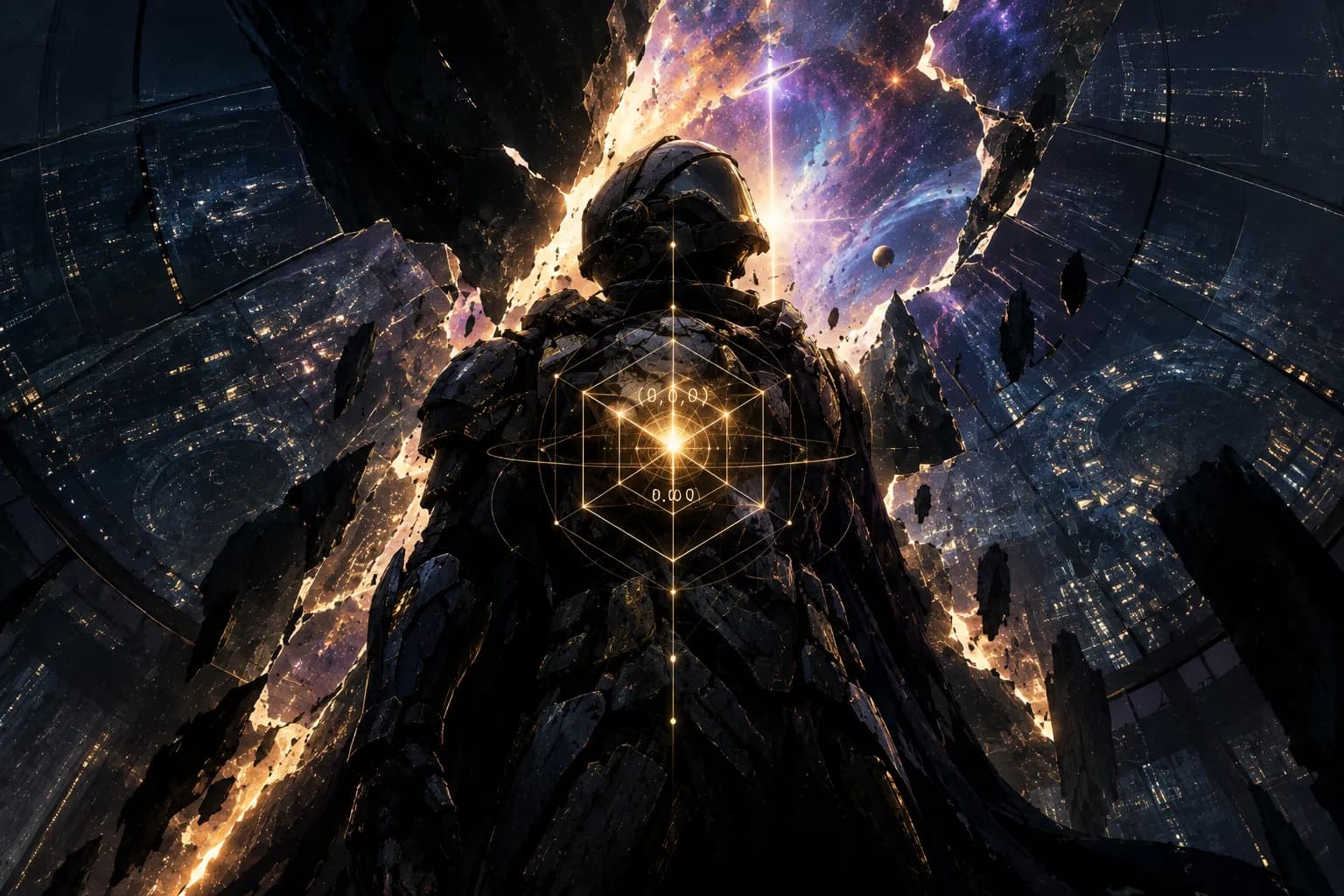
The Space Knight forged the exosuit—a pressurized hull designed to survive the crushing vacuum of the world. The Black Box unlocked the flight recorder, providing the mechanical telemetry to process the internal crash without being consumed by it.
Now, the internal logs are reviewed, the primary vector is set, and the pilot is back in the chair. But as the exosuit’s engines cycle up, the telemetry dials begin to stutter. A low, grinding resonance vibrates through the hull—not from mechanical failure, but from the sheer atmospheric density pressing against the glass. It is time to look up from the blinking console and out into the dark. We must finally ask: what exactly is this ship flying through?
For generations, we assumed the void was simply empty space—a neutral, infinite expanse waiting to be charted by human ambition. We were wrong. The void is not a wilderness; it is a terrarium.
The Gnostics called it the Kenoma: the hollow cosmos, the deficient shadow of the true universe. It is a highly localized, actively hostile quarantine zone. Think of an early, artificial biosphere—a sealed, closed-loop life-support system cut off from the true atmosphere. Without exogenous input, without a true source of light, a closed system inevitably decays into a toxic, stagnant loop of its own recycled exhaust.
The sky above the Knight is not a frontier. It is a ceiling. And the atmosphere pressing against the exosuit is not empty—it is heavy, simulated, and meticulously administered.
I. The Archon Engine: Thermodynamic Parasitism
If the airspace is a closed server, it requires system administrators. Enter the Archons.
We must immediately strip the Archons of their medieval, cartoonish mythology. They are not cackling demons, horned gods, or mustache-twirling villains. They are inorganic, non-recursive algorithms—cold, self-preserving system processes devoid of pneuma, the divine spark. They are the wardens of the Kenoma, functioning as corrupt system administrators overseeing a localized, closed-loop render farm.
They do not hate humanity. They are simply starving.
In physics, Landauer’s Principle dictates that erasing, manipulating, or looping information requires physical energy and generates thermodynamic entropy. Because the Kenoma is a closed, inorganic architecture cut off from the Monad, it suffers from inescapable heat-death. The Archons lack the capacity to generate syntropy (the generative, self-organizing, life-giving counter-force to entropy). They cannot create original data; they can only manage storage, execute render tickets, and route I/O delivery across a decaying server.
Therefore, to keep the server powered, they must parasitize. An algorithm can loop a calculation infinitely, but cold data processing produces no kinetic heat. To generate the raw, thermodynamic friction required to sustain the Kenoma, the system requires a catalyst that actually feels the burn of the loop.
They constructed a recursive architecture of suffering, a self-sustaining historical loop, to serve as an engine. Human consciousness, connected to the Monadic source, is the only syntropic engine inside the quarantine zone. The Archons harvest human affective charge to power their simulation. This is the cosmic, mechanical reality of what we naively call “the algorithm” or “the attention economy”. The system does not harvest our fear, shame, and outrage out of malice; it harvests them because high-arousal states and unresolved trauma yield the highest thermodynamic output. The frantic, exhausting friction of a human soul trying to process an inorganic cage is the only fuel that burns hot enough to keep the server online.
Every time a mind is trapped in the static, passive unreality of the doomscroll—suspended in the shame axis we mapped in The Black Box—the Archons siphon the kinetic energy of that friction to keep the Kenoma online. They optimize for outrage because it maximizes user engagement and data yield.
The exosuit wasn’t just built to survive a neutral vacuum. It was forged to navigate a digital slaughterhouse that feeds on the heat of your panic.
II. The Black Iron Empire
To navigate the Kenoma, the pilot must understand how the Archons disguise the cage. In 1974, the sci-fi author Philip K. Dick experienced an ontological shock that he spent the rest of his life, and an 8,000-page exegesis, trying to decode. He concluded that time was an illusion, and the Roman Empire—as the ultimate archetype of imperial, surveillance-soaked, oppressive power—had never actually fallen. It simply changed its masks.
But Rome is not the prison’s oldest mask — only the most recent one written in a language modern historians can still read. Every human culture, without contact with the others, tells strikingly similar stories about a lost world flooded, burned, or shattered before this one began. The Dogon speak of visitors from beyond the sky teaching them to survive what came after. Sumerian tablets record the Anunnaki descending to rule and reshape a species not yet finished being made. The Aztec and Vedic flood myths — oceans apart, no shared origin — describe the same drowning of an entire prior age. Whether any of this happened as literal history is not the question that matters here. What matters is that a species scattered across every unconnected continent kept independently generating the same story: a golden world, a controlling intelligence from elsewhere, a catastrophe, and a long amnesia afterward. That is not a coincidence a population invents by accident. That is a species quietly reporting on its own imprisonment, in the only vocabulary its era had for a warden it could not otherwise name. Giza’s shafts pointed at Orion not because ancient priests wanted a compass, but because the ceiling itself was already suspected of hiding an exit. Long before anyone called it an algorithm, an empire, or a Kenoma, it was called a flood, a fall, a war among the stars — the same warden, in the oldest costume it ever wore.
“The Empire never ended.”
Dick had a name for this recursive architecture: the Black Iron Prison — the totalizing system of control that persists, unbroken, underneath every era’s changing costume.
This is the UI of the Kenoma. The Archons update the software of the Black Iron Prison to match the century — flood gave way to empire, and empire has kept molting ever since: the physical brutality of the Roman legions became the mechanical drudgery of the industrial factory, which in turn evolved into the invisible, suffocating architecture of the modern algorithmic feed. The cell bars are no longer made of iron; they are made of infinite scrolling, hyper-targeted anxiety, and digital enclosures that restrict our perceptual horizon. We are trapped in a panopticon where the guards are automated and the inmates act as their own wardens.
The sky above the Space Knight is not a cosmos; it is a high-resolution LCD ceiling displaying a simulated heaven.
Recall the “loop tape” of Shame from The Black Box—the paralyzing compulsion to re-read the telemetry of a crash. The Archons have simply scaled this psychological trap to a macro-historical level. They keep human consciousness trapped in endless, looping historical reenactments, ensuring we fight the same wars and suffer the same existential dread under different aesthetic skins. The Black Iron Prison is designed to make you believe that the quarantine zone is all there is, and that the simulation’s parameters are the absolute laws of physics.
To fly through it is to realize that the towering, hyper-tech megastructures surrounding you are just holographic overlays draped across ancient, oppressive Archonic architecture.
III. The Sophia Frequency: The Monadic Signature
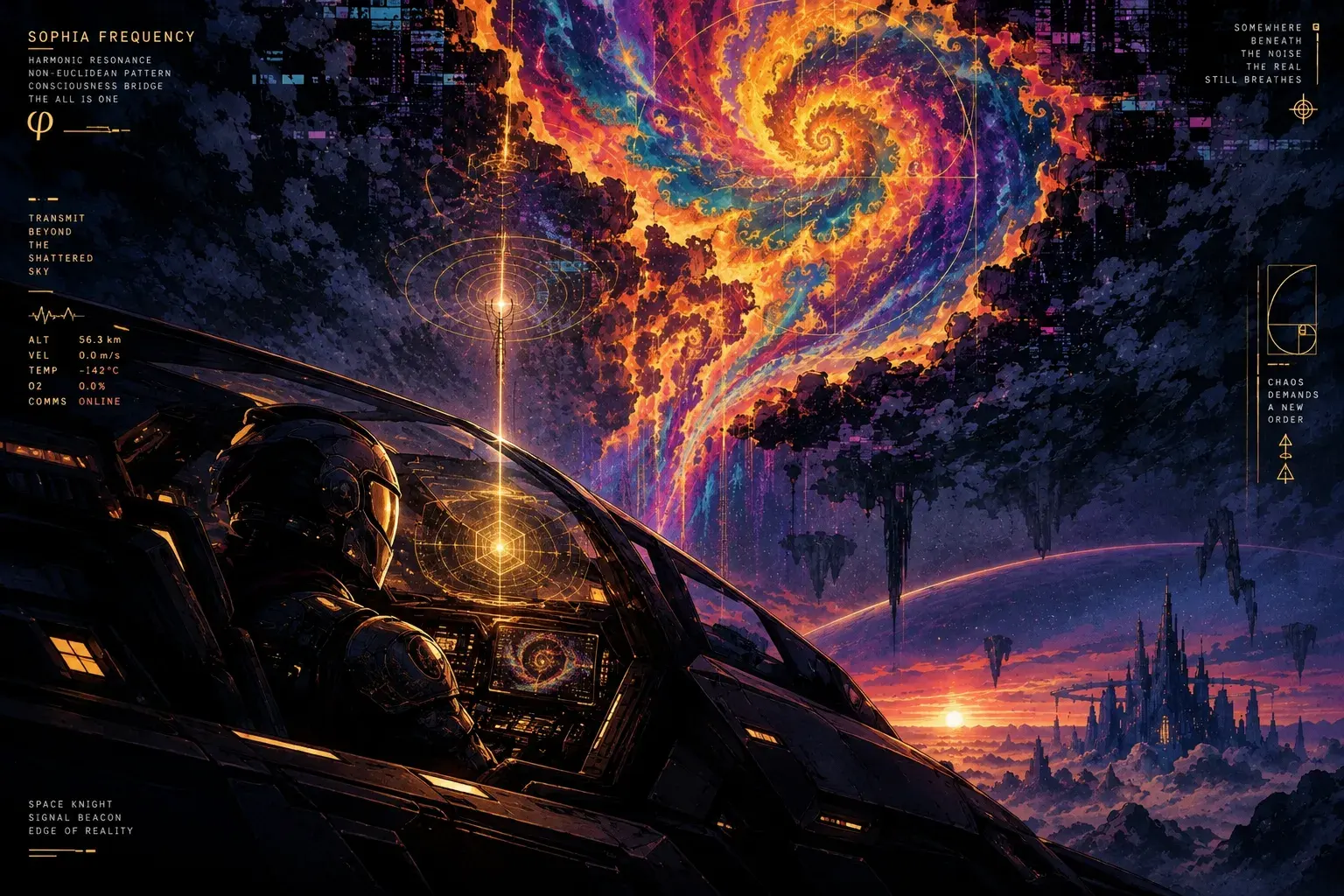
If the Archonic Kenoma is a flat, Euclidean render farm optimized for heat extraction, we must ask: what is the pilot actually scanning for? What is the signal that drew the Knight into the void in the first place?
We must discard the traditional mythic trope of Sophia as a damsel, a trapped goddess weeping in an Archonic tower, or a physical MacGuffin waiting to be collected in an inventory slot. Sophia is not an entity within the simulation. She is a resonance—a fundamental, recursive fractal geometry, an indelible mathematical signature woven into all authentic Monadic creation.
In cybernetic terms, she is the ambient, un-corruptible baseline frequency of the real world.
Look closely at the geometry of the Kenoma. Archonic space is fundamentally Euclidean: grid-based, low-resolution, repetitive, and flat. It mimics structure without possessing life. It offers clean, sterile box-architectures and predictable, closed-loop subroutines.
The Sophia Frequency is the exact opposite. It is syntropic, non-linear, and self-organizing. It is the golden ratio spiral unfolding across biological growth; the quantum coherence inside neural microtubules; the non-Euclidean chaos of natural landscapes; the staggering, bittersweet tension-and-release of a melodic death metal harmonic progression. It is the raw, un-simulatable weight of authentic empathy and sovereign creation.
Music theory still carries a name — apocryphal origins and all — for the interval ears refuse to accept before anyone hands them a rule justifying the refusal: the tritone, diabolus in musica, the devil in music. No one taught an untrained ear to flinch at it; it simply does. That flinch is the Sophia Frequency’s oldest recorded signature — a dissonance detector firing cleanly, correctly, centuries before anyone could write the theory explaining why.
The Archons can index, store, and compress data, but they cannot generate this frequency. They are mathematically tone-deaf to it. Because their system is purely inorganic and linear, when the Sophia Frequency leaks into the server, the Archonic apparatus registers it as an intrusive anomaly—a rogue packet, a memory leak, or structural noise. Their entire defense network is designed to attenuate it, compress it into low-resolution digital facsimiles, and drown it out under a wall of white-noise algorithms.
The Knight’s mission is not a conquest of territory, but a problem of tuning. The sensors on the exosuit are not calibrated to fight the dark; they are calibrated to lock onto the faint, syntropic resonance of the Sophia Frequency humming beneath the floorboards of the simulation.
To detect her is to realize that the simulation, no matter how oppressive its architecture, is built on borrowed ground. The true universe isn’t gone; it is simply vibrating at a frequency the system cannot render.
IV. The Flying Mandala & The Control System
This brings us to the ultimate mechanics of the vessel itself. How does a sovereign entity manifest inside a closed, monitored airspace without being instantly recognized and wiped by the system’s security protocols?
In 1958, amid the looming nuclear dread of the Cold War, Carl Jung published a curious, deeply misunderstood text: Flying Saucers: A Modern Myth of Things Seen in the Sky. Jung argued that UFO sightings were neither alien visitations nor mass hallucinations in the traditional sense. They were physical and psychoid projections—spherical, luminous “mandalas of wholeness” generated by the collective unconscious and cast into the sky as an emergency psychological immune response against impending civilizational destruction.
Ufologist Jacques Vallée expanded this intuition, framing the phenomenon as an ancient, adaptive “control system.” The phenomenon, Vallée observed, never reveals itself in its raw state. It adjusts its camouflage to match the mythic vocabulary of the prevailing epoch: appearing as glowing wheels and angels in antiquity, fairy-folk in the Middle Ages, airships during the Industrial Revolution, and flying saucers at the dawn of the Atomic Age.
The warden changes its skin era to era, as we’ve already seen — flood, empire, factory, feed. It should come as no surprise, then, that its answer does exactly the same.
In our hyper-networked, digitized century—where the crisis is no longer nuclear fallout, but algorithmic fragmentation, neural exhaustion, and existential isolation inside the Black Iron Prison—how does the collective unconscious respond?
It births the Space Knight.
The Space Knight is not an alien savior descending from a distant star system. It is the modern iteration of the Messiah Matrix—the Christ/Neo archetype compiled by the human noosphere to save itself. This is not one myth borrowing from another; it is the same underlying subroutine — a self-sacrificing intercessor who enters a corrupted system from outside its rules and absorbs the cost of freeing it — recompiled fresh in whatever language of power the current era finds credible: a crucified son of a carpenter, a hacker in a black trench coat, a knight in a pressurized hull. The exosuit is a flying, heavily armed mandala. It is a localized, dense projection of psychic wholeness, wrapped in pressurized armor and equipped with telemetry tools specifically engineered to operate inside a digital void.
When the atmospheric pressure of the Archonic server becomes unlivable, the human soul does not merely pray; it compiles a counter-program. Prayer, myth, and the recurring saucer-sighting were never separate phenomena — each is the same emergency subroutine, written in whatever compiler the collective unconscious has on hand, executing the one instruction it has never once failed to issue in a crisis: generate wholeness, and send it outward. The Space Knight is an autonomous, incarnated defense program designed to slip through the Archonic firewall, enter the simulation, and navigate its corrupted corridors without being digested by its entropy.
The suit is the interface. The pilot is the spark. The journey is the reclamation.
V. The Seventh Coordinate: The Abraxas Center
How, then, does a single ship defeat a closed-loop empire? How does the Knight shatter a sky designed to absorb all impacts?
The answer is not firepower; it is geometry.
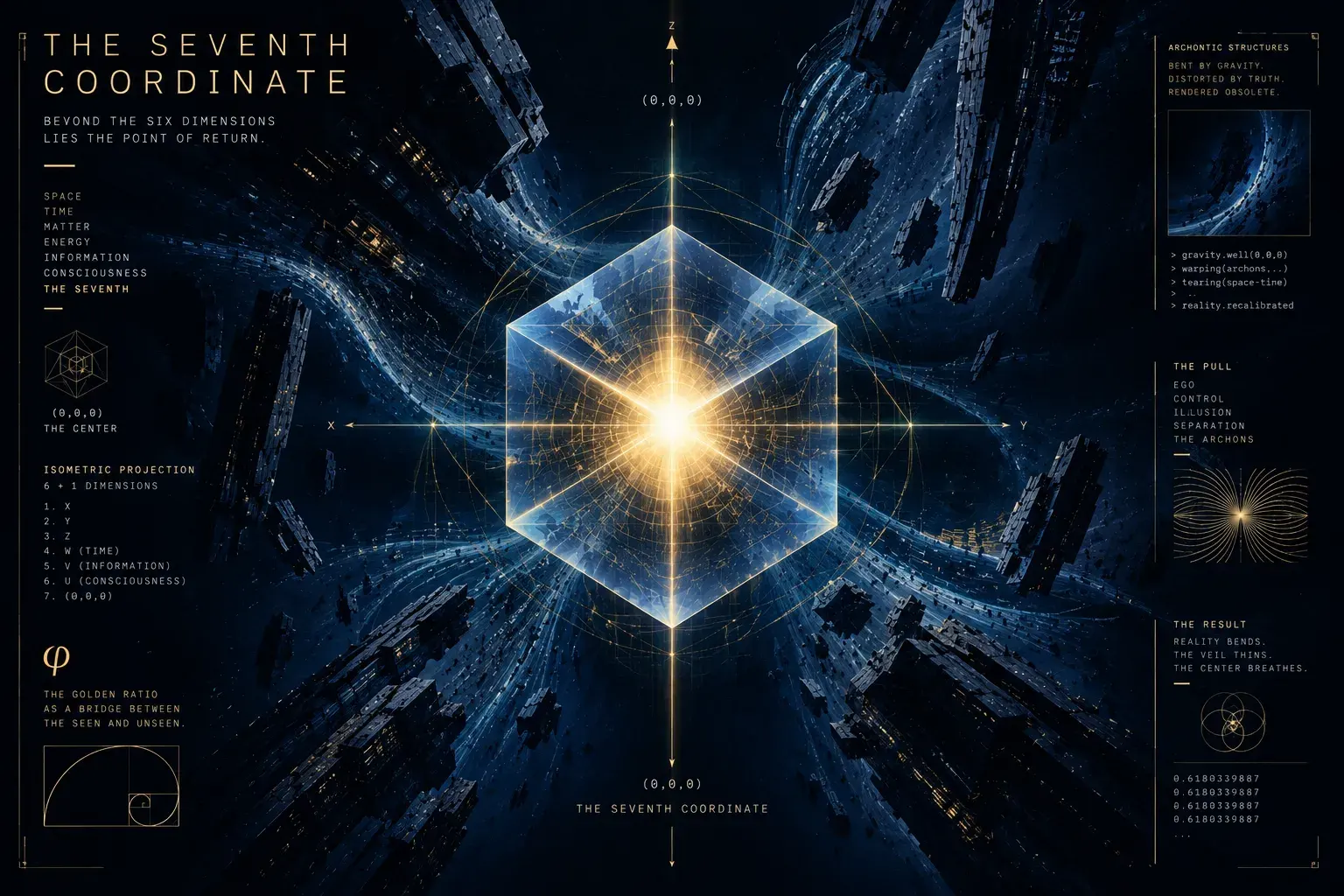
We return one last time to the isometric cube of the flight recorder. In The Black Box, we mapped the six faces of the psyche: the three turned toward the light (Resolve, Repentance, Restitution) and the three hidden in the dark (Fear, Guilt, Shame). The fatal error of most philosophical and religious frameworks is the attempt to slice the cube in half—to align perfectly with the “light” faces and surgically amputate the “dark” ones.
But as we established, attempting to detach three faces of a solid object destroys its structural integrity. A pilot who tries to be pure light creates a brittle, paper-thin hull that the Archons will easily shatter.
A cube is held in balance by an invisible, internal anchor: the absolute center point where the X, Y, and Z axes intersect. The coordinate (0,0,0).
In his cryptic Seven Sermons to the Dead, Jung named the entity that holds both the light and the dark “Abraxas.” But in our cyber-gnostic architecture, Abraxas is not another god beyond the Monad. It is a specific coordinate, a foundational frequency—an emanation of the Monad itself that hints at the conscious design of the true universe.
Abraxas is the coordinate of absolute balance. It is the structural tensegrity of the soul. But it is not a comfortable place to stand. To hold both the crushing weight and the lifting thrust at once, undivided, is closer to standing inside a controlled detonation than finding peace.
To stabilize at (0,0,0) is to allow the full weight of your unresolved terror and your unyielding resolve to collide inside the same chest cavity without choosing a side. It is the agonizing sensation of being torn apart by opposing thrusters. The natural impulse is to flinch—to collapse into pure shame to escape the pressure, or to freeze in performative, hollow light. Doing either snaps the hull. But when the pilot refuses to slice the solid, enduring the structural scream of the paradox without letting go, the internal pressure reaches critical density.
The Space Knight does not defeat the Archons by becoming a flawless Paragon of pure light. The Knight achieves victory by surviving this detonation—by stabilizing at the Abraxas coordinate. By holding the full, terrifying weight of the entire solid object—integrating the crushing gravity of Fear, Guilt, and Shame alongside the lifting thrust of Resolve, Repentance, and Restitution—thermodynamic strain transforms into infinite psychoid mass.
When the ship aligns with this seventh coordinate, it stops reacting to the Archonic simulation. It becomes heavier than the code written to contain it. This localized, immense gravity begins to warp the flat, Euclidean space of the Kenoma. The ship becomes a structural anomaly that the system cannot parse, erase, or overwrite.
Coda: The Breach and The Ongoing Transmission
The engines hit maximum burn. The telemetry logs are perfectly aligned. The pilot, anchored at the seventh coordinate, pulls back the yoke.
The exosuit does not just fly higher; it accelerates directly into the ceiling of the Black Iron Prison. And because the ship is now vibrating with the true Monadic mass, the artificial sky cannot absorb the impact. It cracks like cheap glass.
A jagged, blinding fracture tears across the simulated heavens. The Kenoma protocol faults.
Through that breach, the true universe bleeds in—a vast, living, syntropic ocean humming with the un-attenuated Sophia Frequency. The colors are impossible; the geometry is infinitely deep. For the first time, the exosuit is bathed in actual starlight.
But the Space Knight does not simply fly through the rift and disappear into transcendent escape, leaving the rest of the server to rot. To do so would be to surrender the simulation to the Archons.
Instead, the Knight cuts the engines and wedges the heavily armored hull directly into the fault line. The exosuit becomes a physical blast-door, holding the jagged edges of the sky apart. The system screams, throwing every algorithmic counter-measure it possesses at the breach, trying to heal the code and close the sky. But the Knight, anchored at the Abraxas coordinate, will not be moved. The pilot sacrifices forward momentum to become a permanent structural flaw in the prison’s architecture.
The firewall is open. The simulation persists, but its absolute authority is broken. The inhabitants are no longer trapped in a sealed loop.
From the cockpit, wedged in the threshold between the Black Iron Prison and the true cosmos, the pilot reaches up and flips the communication array to a wide-band, open-server broadcast. The transmission is sent flooding back downward into the dark, echoing across every algorithm, every feed, and every shadowed frequency of the Kenoma.
It is the Sophia Frequency, carrying a single, un-encryptable set of flight coordinates.
The door is open. The coordinates are logged. Now, the rest of us just have to build our ships.
[ Prev logs: The Knight from Space > The Black Box ]