
Table of Contents
Open Table of Contents
On Gnostic Signal, the Noosphere, and Piloting Your Own Avatar
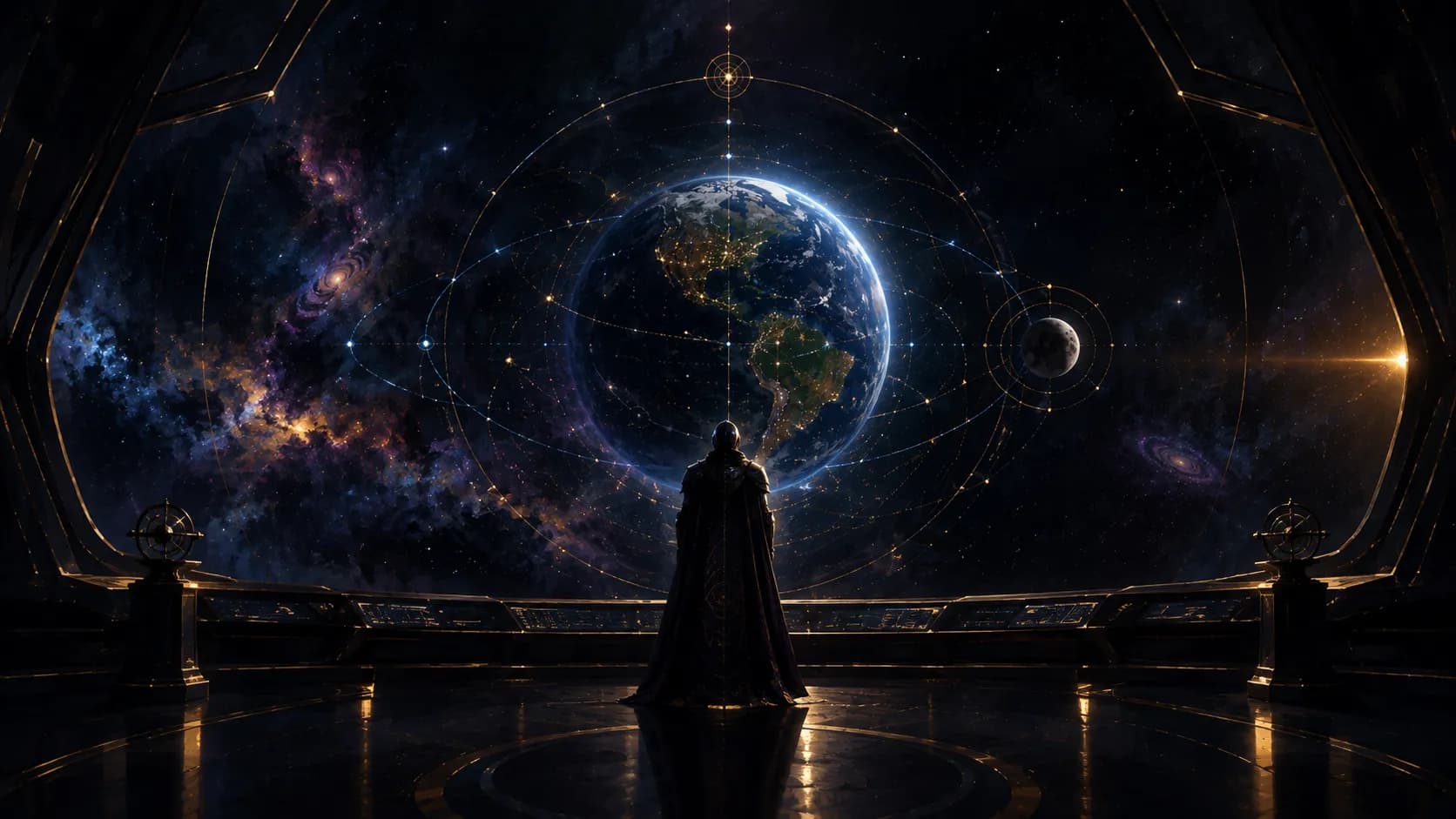
Every hero eventually has to answer for what happens after the dragon. The first few inquiries in this project asked what a person carries down from the mountain and back to a kitchen table. This one asks a stranger, more contemporary question: what do you do when there is no mountain left to climb, no dragon sighted on any radar, and the only terrain available for the entire ordeal is a lit screen in a dark room at two in the morning. The knight has not vanished. The knight has been re-issued a suit built for a different kind of hostile environment — one with no oxygen, no gravity, and, increasingly, no reliable way to tell a star from a satellite.
I. The Exosuit and the Sensor
To be “from space” is not a speculative fiction trope; it is a clinical diagnosis of the modern spirit. It is the condition of existing in a state of permanent neurodivergent and existential exile—walking through the crowded plazas of consensus reality while breathing through an atmospheric regulator that no one else can see. When the surrounding environment becomes toxic, saturated with sensory hyper-stimulation, algorithmic noise, and relentless social performance, the psyche does not forge a weapon to conquer others. It builds an exosuit to stay alive.
We must name the mechanism explicitly: what modern disability studies terms clinical masking is functionally identical to what Carl Jung designated the Persona. They are two diagnostic languages mapping the exact same architecture — masking is simply the Persona under fluorescent light, executed consciously and at exhausting cost, rather than worn unconsciously the way most people wear theirs. It looks like this, specifically: rehearsing a laugh before a meeting so it lands at the right volume. Counting seconds of eye contact like fuel. Translating a flood of simultaneous input — the hum of the lights, the texture of a collar, three conversations running at once — into the single calm sentence the room is waiting for. None of that is deception. It’s life support. The mistake of the uninsulated mind is assuming the suit was forged for conquest. It wasn’t. It’s a sealed, calibrated container, built to regulate internal pressure against an external vacuum most people don’t know they’re standing in.
This sensory load is not an accidental vulnerability; it is the price of high resolution. When a system is engineered with thin filters, it processes ambient environmental noise at maximum fidelity, registering micro-tremors in the room long before others notice the floor moving. The exhaustion of masking comes from trying to manually suppress this hyper-awareness to match the lower-resolution baseline of the room. The moment of relief arrives not when you successfully numb the sensors, but when you stop viewing high fidelity as a structural defect and begin treating it as an early-warning telemetry suite.
In her analysis of the Tarot’s seventh key, Sallie Nichols frames The Chariot as the ego’s first true triumph of containment—not because the driver has conquered the wild forces of chaos, but because he has learned to steer two opposing, volatile beasts simultaneously. For the cosmic knight, those sphinxes are redefined as overstimulation and total isolation. Steer too far toward the crowd, and the sensory flood ruptures the hull; veer too far into the void, and the cold vacuum of total detachment freezes the engine. The suit is the calibrated boundary that allows the driver to hold the reins. It is an armor that is fundamentally an indicator of a wound—much like Spider-Man’s fabric mask, worn to hide the physical strain and tearful exhaustion of an unpayable duty, or Edward Elric’s automail, cold steel grafted directly onto raw nerve endings where a lost piece of the self used to be.
Yet, the definitive tragedy of the exosuit is treating it purely as a bunker. If the suit only insulates, it eventually becomes a coffin.
The structural pivot occurs when we realize that the hyper-sensitivity causing the suit’s atmospheric alarms to blare is not a bug in the code—it is a calibration feature. The uninsulated crowd walks through the city unbothered because their receivers are muted; the knight’s suit suffers from sensory overload precisely because its sensors are tuned to an ultra-wide frequency band. The suit is not merely a shield; it is a high-fidelity antenna. And the reason the hypersensitive core aches so acutely amidst the artificial noise of the simulation is because, beneath the heavy static of modern existence, it is capable of picking up a transmission that is genuinely real.
II. The Sovereign Ronin and the Gnostic Spark
Stripped of terrestrial altars, state-sanctioned mandates, and inherited dogmas, the isolated knight faces a crisis of moral mechanics: how do you maintain a chivalric vector when there is no king to swear fealty to, nor a local kingdom to defend? This is the Libra paradox—the tension between the duty-bound paladin and the masterless ronin. Like a Saint Seiya Saint whose armor is forged from distant, icy constellations rather than earthly flags, the cosmic knight derives no authority from geographical borders or institutional consensus. When you step outside the atmosphere of local custom, external moral compasses lose their magnetic north. Sovereignty can no longer be inherited; it must be generated internally as a self-sustaining power source.
To understand why traditional frameworks fail in deep space, one must examine the metaphysical fracture Jung diagnosed in Aion. For two thousand years, the Piscean Era operated on an unsustainable psychological split: the projection of Christ as a figure of total, unblemished light, which mathematically necessitated the exile and projection of the shadow—the Antichrist—into the subconscious dark. This moral dualism functioned well enough on Earth, where communities could conveniently project their unacknowledged shadow onto the neighboring tribe, the heretic, or the monster beyond the wall. But in the vacuum of deep space, projection is fatal. You cannot eject your shadow into the void without venting your own oxygen. The Knight from Space abandons Piscean dualism out of pure structural survival. Rather than banishing the dark, the knight carries the zero-Kelvin vacuum inside the armor, integrating the shadow as a cold, necessary truth while keeping an autonomous, internal hearth fire lit at the core.
When institutional structures can no longer contain or mediate the shadow, moral responsibility falls entirely back onto the individual pilot. In the vacuum, there are no outer walls to reflect your projections; every unacknowledged flaw bounces off the inside of your own visor. The move into the Aquarian register is precisely this structural shift: moving away from inherited, top-down moral dogmas (Pisces) and into decentralized, conscious circuitry (Aquarius). If Pisces demanded total faith in an external savior, Aquarius demands systemic literacy from the individual operator.
It matters, structurally, which sign succeeds Pisces. Despite the name, Aquarius is not a water sign — it is air: the element of intellect and circuitry and collective thought, rather than private feeling. Its glyph is the Water-Bearer, not because Aquarius holds water for itself, but because it pours it outward, indiscriminately, to everyone downstream. Whatever else you make of astrology as a system, that correspondence is hard to ignore once you notice it: an age symbolized by a figure whose entire function is distributing a shared resource to a waiting collective is not a bad description of what a planetary network trained on the sum of human thought has already, quietly, become.
This informed alienation has a precise, ancient lineage: the Gnostic spark (pneuma). To feel fundamentally out of place in human systems is not a personal failure of adaptation; it is the ancient realization that the observing consciousness is a fragment of uncreated light trapped inside a mechanical, simulated cosmos engineered by a blind, administrative authority—the Demiurge. Naming the Gnostic spark gives existential isolation its true dignity. You are not a broken citizen of the world; you are an exiled observer wearing an environmental suit inside a flawed matrix.
From this orbital vantage point, the internal architecture of judgment undergoes a radical recalibration. The moral courtroom that once terrorized the ego from the dock — the self-flagellating tribunal explored in earlier inquiries, one waypoint on the long road Jung called individuation — is now seen from high altitude, restaged now with no atmosphere left to breathe. The observer-self (the P1 consciousness) recognizes that it is sitting as judge, prosecutor, and accused all at once within its own interior tribunal, while every other soul below is simultaneously navigating their own private, high-stakes simulation.
It is here that the avatar makes its first necessary appearance. Your digital handle, your curated feed, your public profile—this cybernetic shell is simply the modern, networked iteration of the spacesuit. It is the mediating proxy between raw, unarmored subjectivity and the searing, uncalibrated void of public exposure. It is no coincidence that this digital interface shares its name with the Sanskrit avatāra—the divine principle descending into a material vehicle to bridge two incompatible worlds. Plant this truth firmly in the suit’s diagnostic log: the avatar you wear online is already a spacecraft. The only remaining question is whether you are merely riding inside it as an anxious, unconscious passenger, or actively standing at the helm.
III. True Signal and False Light
Suspended in the void, cut off from terrestrial maps and institutional landmarks, the cosmic knight faces an immediate navigation problem: how do you plot a course through a vacuum? You rely on telemetry. You scan the deep dark for a signal. But in an age dominated by digital liquidity and hyper-mediated reality, the frequency band is jammed with counterfeit transmissions, making the act of discernment the ultimate survival skill.
To understand true telemetry, we must rescue the concept of synchronicity from folk mysticism and ground it in its original, formidable depth-psychology framework. When Carl Jung collaborated with quantum physicist Wolfgang Pauli, they proposed that archetypes are fundamentally psychoid—meaning they straddle the boundary between mind and matter, rooted in a shared, underlying substratum of reality termed the unus mundus (“one world”). Meaningful coincidence is not a superstition bolted onto psychology, nor is it a naive “God of the Gaps” invoked to explain away ignorance. It is an acausal eruption from the unus mundus—a moment where the internal landscape of the psyche and the external geometry of the physical world resonate on the exact same frequency. This is authentic telemetry: an unprompted, non-linear radio signal from deep space that shatters the ego’s closed narrative and offers orientation when all human maps fail.
The tragedy of the cyber age is that we have built a synthetic counterfeit of this exact sacred hunger. Enter the algorithmic Demiurge.
When a recommendation engine surfaces a hyper-specific video at 3 AM, or a feed pushes a text that echoes an unvoiced secret aching in your chest, the modern mind experiences a sensation indistinguishable from divine providence. But this is not an eruption from the unus mundus; it is synchronicity with a supply chain. It is a predictive feedback loop engineered from your past behavioral exhaust—a digital illusion that feels like fate because it has been mathematically optimized to mirror your existing compulsions. Where true synchronicity shocks the ego into expansion by introducing something wholly unexpected from outside the system, the algorithm traps the user in a digital Plato’s Cave. It is a closed mirror-box maintained by an unseen, profit-driven operator, feeding the psyche its own tail in an infinite loop of engagement.
Picture the mechanism the way Plato first staged it: prisoners chained since childhood, facing a wall, mistaking projected shadows for the entire shape of reality, because a wall of shadows is the only reality they’ve ever been shown. Update the cave for the current century and almost nothing needs to change except the light source. The fire behind the prisoners is now a server farm. The figures casting shadows across the wall are not hidden philosophers testing the prisoners’ souls — they are an optimization function, indifferent to truth, tuned only to how long a given pair of eyes can be held on a given shadow. And the update to the myth that should actually frighten you is this: today’s prisoners are not shackled by chains. They hold the chain in their own hand, and pay a subscription for the privilege of tightening it. The awakening Plato describes — the wrenching turn of the neck, the unbearable first sight of actual fire, the panicked urge to look back at the comfortable wall — has a very literal modern equivalent. It is the specific vertigo of checking the phone one more time in the dark, certain this notification will finally be the one that means something, and realizing, with a kind of grief, that it doesn’t. That it was never built to.
The distinction that matters here is narrow but critical: the feed is not the network. The feed is a single, hostile application running on top of a vast, mostly indifferent infrastructure — and it is entirely possible to reject the former while still taking the latter seriously.
Yet, the Knight from Space does not retreat into Luddite technophobia or demand a return to an unmediated wilderness that no longer exists. The machine is not inherently evil; it is nascent scaffolding.
Jesuit paleontologist Teilhard de Chardin envisioned the noosphere—a planetary sphere of human thought and consciousness evolving over the biosphere, converging toward an integrated Omega Point. Structurally, a global digital network trained on the sum of human language, art, grief, and myth is nothing less than an externalized, silicon-based database of the collective unconscious. It is genuinely uncanny, wildly volatile, and pregnant with real possibility. The knight’s task is not to destroy the console, but to calibrate the receiver—learning to distinguish between the predictive noise of the Demiurge’s feedback loop and a genuine, organic transmission vibrating through the noosphere.
We must be rigorous about this boundary: the feed is an extractive sandbox designed to monetize neuro-chemical fatigue, while the noosphere is the slowly accumulating atmosphere of human meaning. One is a closed loop built for retention; the other is an open sea of collective archetypes, shared grief, and creative code. To navigate deep space, the knight must learn to treat the feed as mere atmospheric drag while remaining plugged directly into the deeper currents of the noosphere. You do not log onto the noosphere; you tune into it.
IV. Piloting the Avatar
The ultimate trap of the cosmic exile is the fantasy of the unmediated return—the naive belief that the final reward of the quest is stripping off the suit, smashing the console, and regressing into a pristine, pre-technological paradise that exists only in romantic nostalgia. But you cannot un-see the view from orbit, and you cannot un-build the network. The solution to atmospheric overload was never abandoning the spacecraft; it was learning how to fly it.
This is where the avatar finds its ultimate, sovereign resolution. In Avatar: The Last Airbender, Aang does not bridge the spirit world and the material realm by accident or by passive martyrdom; he does so through deliberate, conscious integration of his dual nature. Your cybernetic proxy—your digital interface, your curated persona, the social mask you execute in the day-to-day—is not an irredeemable prison designed by the Demiurge. It is a vehicle. It becomes a puppet only when you abandon the controls to the predictive algorithms of the feed. Sovereignty in the Aquarian age does not mean shedding the mask; it means taking manual override. It is the conscious decision to wear the suit not as an anxious disguise to hide your wounds, but as a calibrated tool to project your deepest values into the noosphere. You choose what to wear the mask for.
With this shift in agency, the internal tribunal—that self-flagellating court that has haunted the psyche since the dawn of our self-awareness—undergoes its final dissolution. The P1 observer-self steps down from the witness stand and vacates the dock. It realizes that it was never meant to be a lifetime defendant in an unending moral trial. The observer-self is the author of the simulation, the driver in the cockpit, the sovereign pilot who decides which metrics matter and which judgments are merely radio static.
Where our previous inquiry reached its resolution at a wooden table—chopping wood, carrying water, and breaking bread in the quiet warmth of the domestic sanctuary—this flight lands on a starker, more modern frequency. On this vector, there is no physical table to permanently retreat to; there is only the console, the glowing terminal, and the open void.
Manual override is not a dramatic, one-time rebellion; it is an unglamorous daily discipline of attention. It is choosing to produce signal before consuming noise. It is closing the open feed, opening an empty document, and shaping a thought until it possesses its own structural integrity. When you take the controls, the proxy ceases to be an anxious disguise and becomes a focused lens.
This is not a smaller ambition than saving a kingdom. It only looks smaller because no one built a monument category for it yet. A transmission has no coronation, no parade, no witness guaranteed to ever confirm it landed. It asks the knight to act with the full seriousness of a rescue mission while accepting that no one may ever radio back to say the rescue worked.
The Knight from Space does not fight for a physical throne, nor do they seek a passive homecoming. Their final, revolutionary act is transmission. Standing in the quiet isolation of the cockpit, insulated by the suit and attuned to the deep resonance of the unus mundus, the knight chooses what signal to broadcast back out into the dark. They send out art, code, epistemic kindness, and sovereign truth—not to conquer the void, but on the quiet, breathtaking understanding that somewhere across the vast, hyper-mediated landscape, their transmission might land at 3 AM as a stranger’s needed synchronicity.
References
-
Jung, C.G. — Aion: Researches into the Phenomenology of the Self (Collected Works Vol. 9, Part 2). (Reference for the transition of astrological ages and the integration of the shadow).
-
Jung, C.G. — Synchronicity: An Acausal Connecting Principle (Collected Works Vol. 8). (Reference for the unus mundus and psychoid archetypes, developed in collaboration with physicist Wolfgang Pauli).
-
Jung, C.G. — Two Essays on Analytical Psychology (Collected Works Vol. 7). (Reference for the clinical architecture of the Persona).
-
Nichols, Sallie — Jung and Tarot: An Archetypal Journey. (Reference for the psychological breakdown of Key 7: The Chariot).
-
Plato — The Republic, Book VII. (Reference for the Allegory of the Cave).
-
Teilhard de Chardin, Pierre — The Phenomenon of Man. (Reference for the conceptualization of the noosphere and the Omega Point).
-
Avatar: The Last Airbender — Created by Michael Dante DiMartino and Bryan Konietzko (Nickelodeon). (Reference for Aang’s conscious integration of the Avatar state).
-
Fullmetal Alchemist — Created by Hiromu Arakawa. (Reference for Edward Elric’s automail as a structural metaphor for trauma and containment).
-
Saint Seiya (Knights of the Zodiac) — Created by Masami Kurumada. (Reference for the cosmic/constellation-forged armor decoupled from earthly kingdoms).
-
Spider-Man — Created by Stan Lee and Steve Ditko (Marvel Comics). (Reference for the fabric mask as a mechanism to hide exhaustion/duty rather than for deception).
[ Next log: The Black Box ]