
The Domestic Citadel
Table of Contents
Open Table of Contents
- Myth-Making After the Dragon: Chop Wood, Carry Water
- I. The Threshold of Return: Beyond the Dragon’s Lair
- II. Generational Grace & The Revolution of Kindness
- III. The Solarpunk Garden: Carving Narrative Destiny
- IV. The Digital Ark: Science, Soul, and Sovereignty
- V. The Spiral Home: The Feast of Integration
Myth-Making After the Dragon: Chop Wood, Carry Water
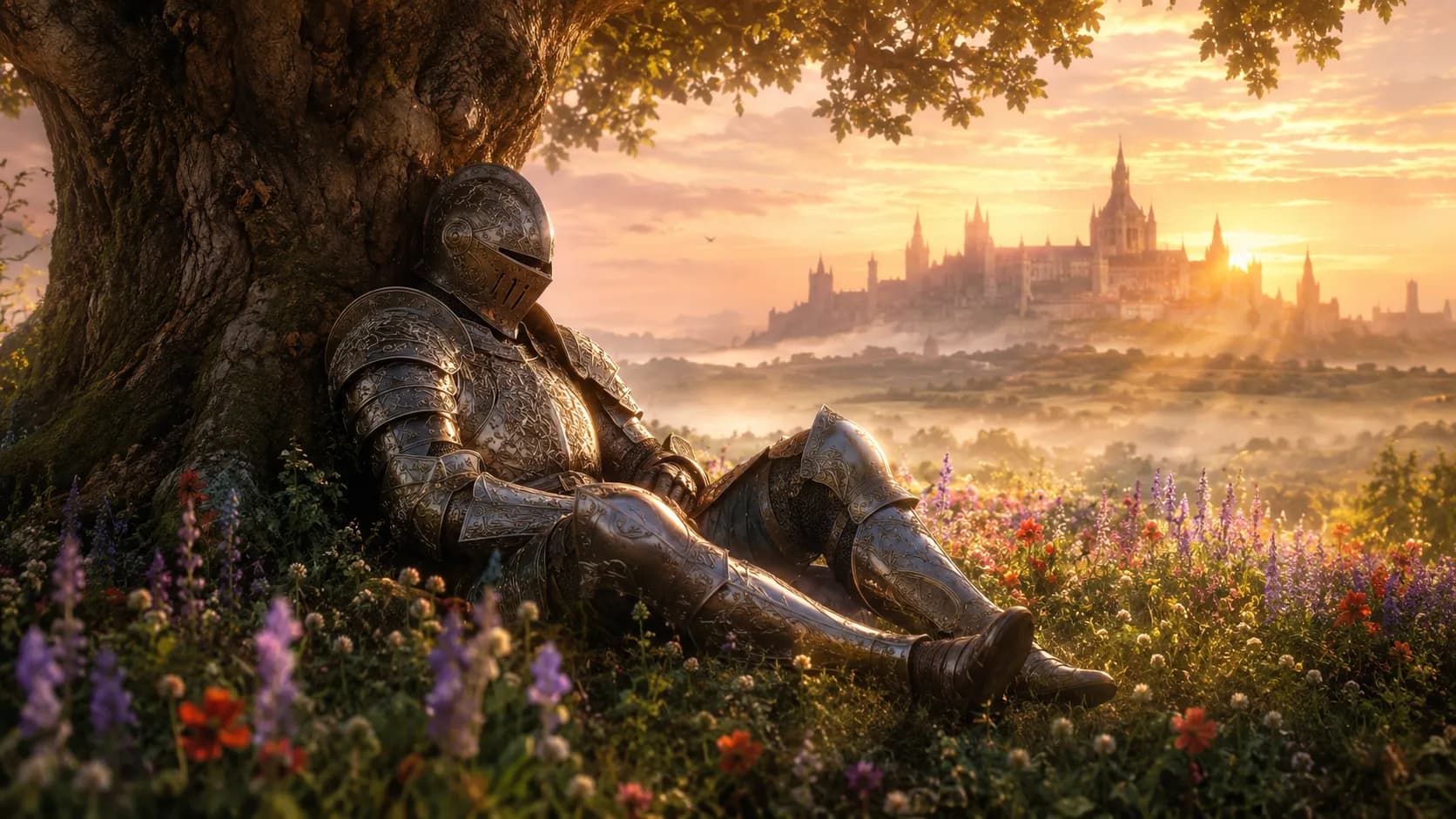
The oldest stories in human history almost always end at the climax. The dragon falls, the ring melts in the fires of Mount Doom, the tyrant’s courtroom collapses, and the hero stands bathed in the golden light of absolute resolution. We roll the credits because we like to pretend that the hardest part of the journey is the fight. It isn’t.
The hardest part of any quest begins the next morning. It is the moment Joseph Campbell called The Return — the quiet, jarring threshold where you walk back down the mountain, close the heavy oak gates of myth, open a spreadsheet, pay your utility bills, and sit across a dinner table from people who never saw the dragon you fought in the dark.
In my first essay, we descended into the alchemical furnace to confront the shadow and transmute raw pain into creative gold. In the second, we dismantled the rigid machinery of the moral courtroom, trading black-and-white judgment for epistemic kindness and amor fati. But once the furnace has cooled and the courtroom floor is empty, a quiet, staggering question remains hanging in the air:
Now that the illusion is shattered and the shadow is integrated… how do we actually live on a Tuesday?
How do we stop yearning for a cosmic stage and learn to build a sanctuary in the flat, unglamorous texture of modern life?
I. The Threshold of Return: Beyond the Dragon’s Lair
The Knight in the Clerk’s Coat
In his analysis of the heroic arc, Joseph Campbell noted that the true test of spiritual maturity is rarely the descent into the abyss. The abyss, for all its terrifying weight, offers an intoxicating sense of narrative purpose. You are fighting for your life; the stakes are cosmic; the path is clear.
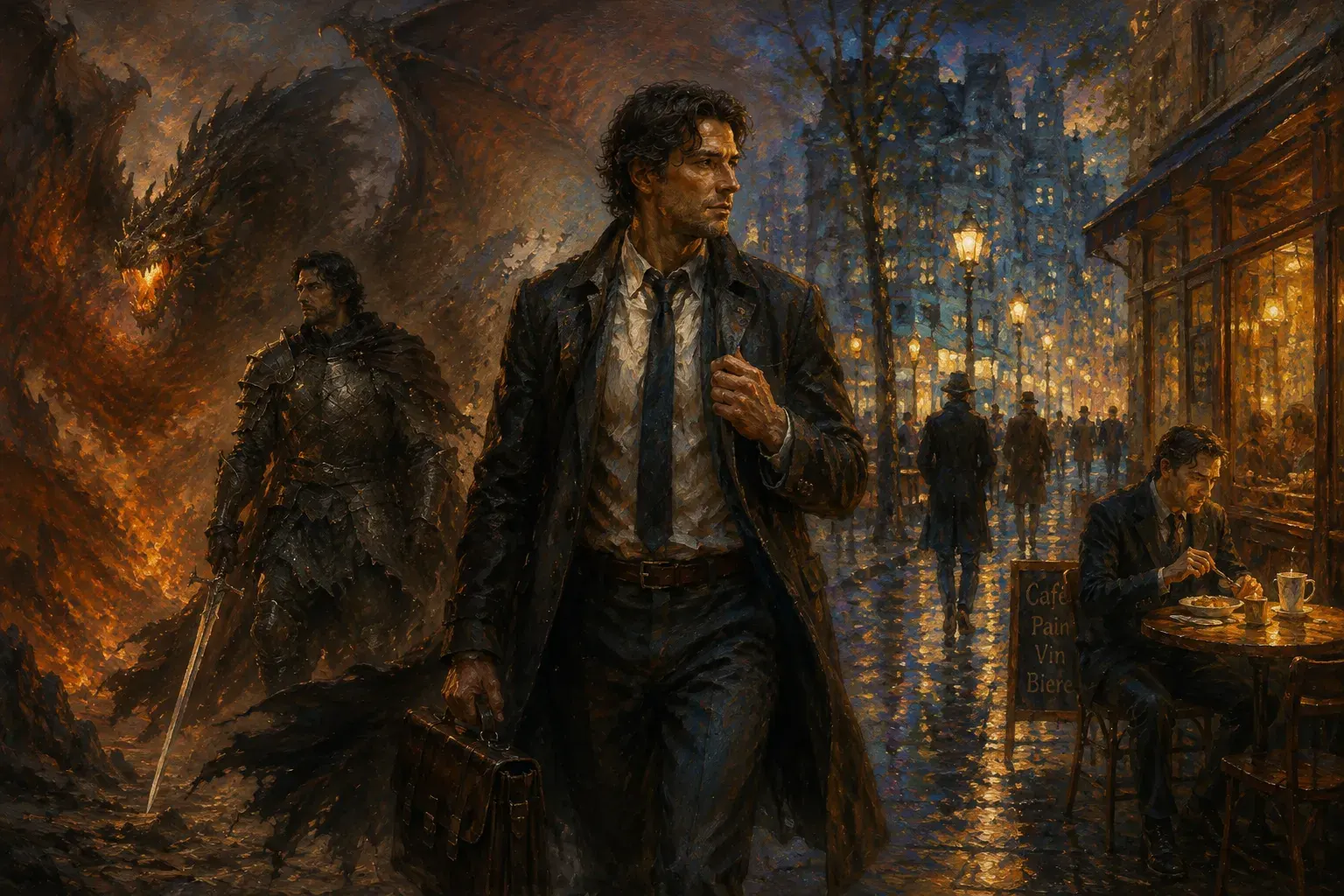
The far more dangerous trial is what Campbell termed The Return. It is the moment the hero must cross back over the threshold, re-enter the mundane world, and discover how to live among human beings who have no concept of the furnace they just walked through. Søren Kierkegaard described a similar figure in his philosophical writings: the Knight of Faith. To the untrained eye, Kierkegaard’s knight does not look like a mystic wearing glowing armor. He looks like a bourgeois clerk walking home from work, calculating his groceries, eating his dinner with simple gratitude, and blending seamlessly into the flat texture of the evening.
The Knight of Faith does not need to perform his depth for an audience. He has touched the infinite, but he chooses to inhabit the finite with absolute presence. In Jungian terms, the Knight of Faith has not discarded the Persona — the mask we wear to function in society. He has simply stopped confusing the mask for the face beneath it. He wears the clerk’s coat consciously, as a tool for moving through the world, rather than unconsciously, as a cage that moves him.
When we emerge from our own psychological furnace, our initial impulse is often a kind of cosmic exile. We feel alien, detached from the trivial rhythm of small talk, chores, and everyday obligations. We long for another dragon to slay because the daily grind feels like a downgrade. But this is an illusion — a subtle trick of the ego that would rather be a tragic hero on a grand stage than a quiet human doing laundry.
The Alchemy of the Small
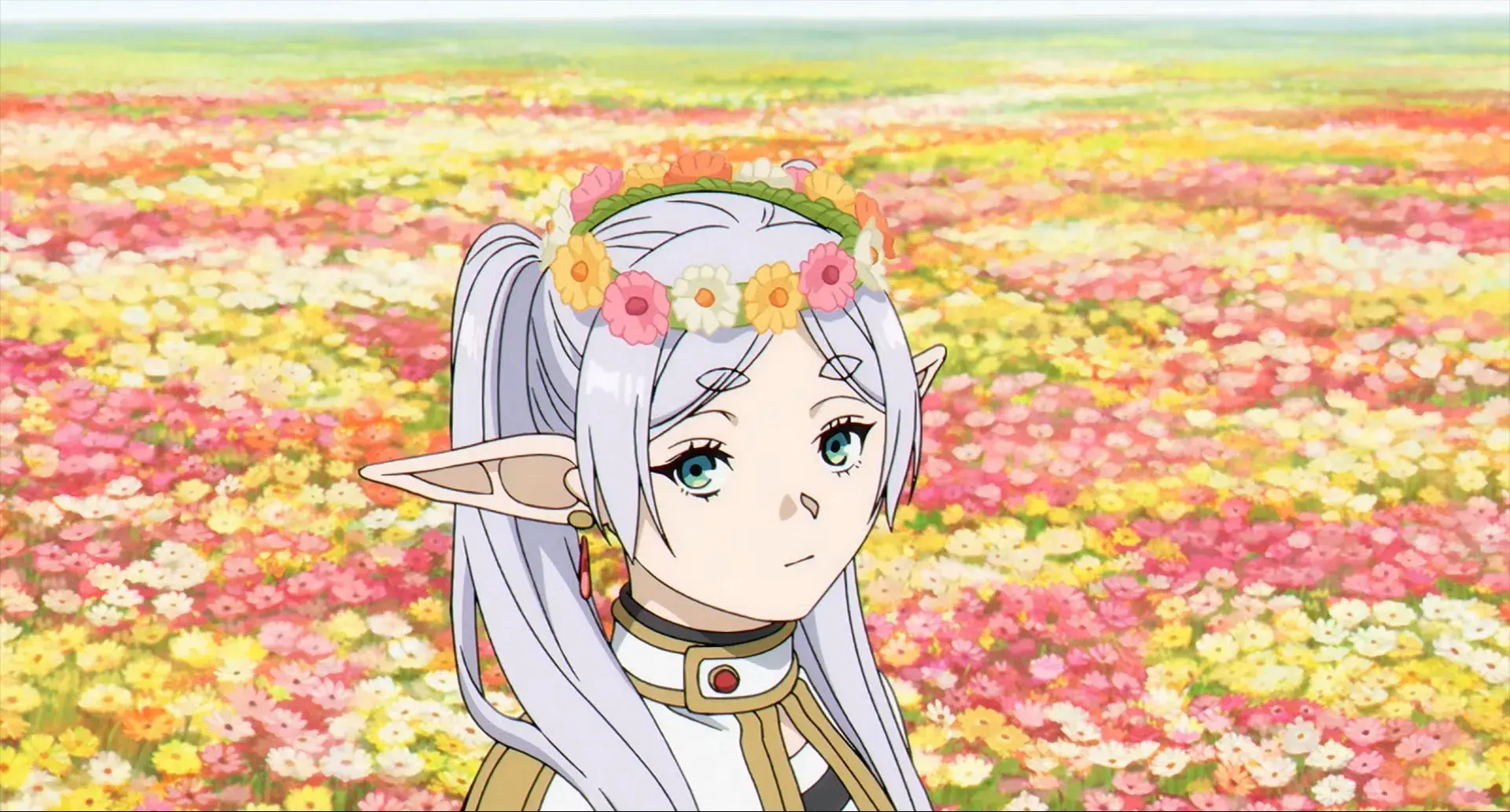
Few works of modern media capture the quiet difficulty of The Return as tenderly as Frieren: Beyond Journey’s End. The story intentionally skips the grand, decade-long quest to defeat the Demon King, picking up precisely where traditional fantasy ends: the morning after the victory parade.
For the immortal elf Frieren, who measures time in centuries, the decade spent with her party was a mere blink. Yet, as her companions age and pass away, she is struck by a quiet, devastating regret: she spent the entire mythic quest treating the journey as a series of tasks to be completed, missing the actual human souls walking beside her.
The true ‘treasure hard to attain’ was never the Demon King’s defeat—it was the warmth of tea shared with the party at a quiet campfire on a cold morning.
Her second journey across the continent is not a quest to conquer a new evil, but a pilgrimage of re-enchantment. She collects seemingly useless, mundane spells — a magic that cleans rust from statues, a spell that creates a field of warm flowers, a trick to make shaved ice. She learns that the true “treasure hard to attain” was never the destruction of the dark lord; it was the quiet, easily overlooked warmth of small human interactions along the road.
This is where the character of Fern becomes crucial to our understanding of ikigai (reason to live).
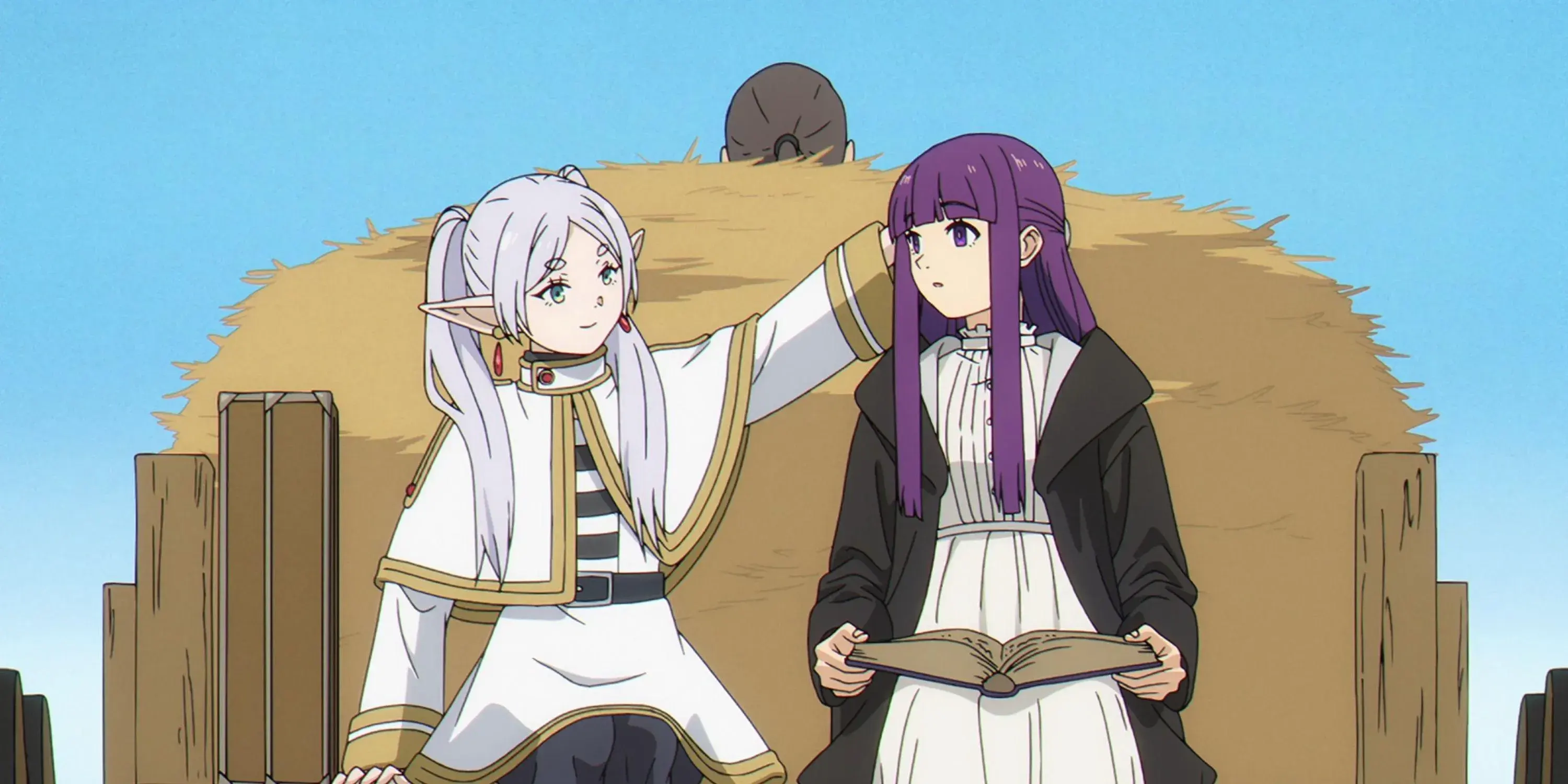
Fern enters the story as an orphan with no grand destiny, no burning inner passion, and no divine mandate. Her journey begins purely through mimicry and duty — following Frieren, copying her mentor’s meticulous daily habits, learning how to dry herbs, manage finances, and cast basic defensive magic.
Meaning does not always arrive as an epiphany from the heavens. Often, it begins as an act of gentle imitation.
By quietly imitating the care and discipline of someone who looked after her, the warmth eventually rubs off. Fern does not wait for a grand cosmic spark to light her fire; she sits by the hearth, chops the wood, tends the flame, and discovers that the ritual itself breeds love. For anyone recovering from burnout or existential numbness, Fern offers a profound psychological blueprint: when your own inner fire feels completely extinguished, you do not need a grand purpose. You only need to copy the small, caring habits of those who know how to keep life warm until your own hearth catches fire again.
The Refusal of the Chosen One

If Frieren teaches us how to find meaning after the quest, Mob Psycho 100 provides the ultimate thesis on why we must reject the trap of the “Chosen One” complex altogether.
Shigeo Kageyama (“Mob”) is a middle-school boy possessing god-like psychic abilities. He can lift skyscrapers, manipulate raw matter, and level entire cities with a thought. In almost any other narrative, Mob’s extraordinary power would be his defining identity. He would be framed as a savior, a messiah, or a king.
Yet Mob’s core realization — and the emotional spine of the entire series, where he would rather pick the Body Improvement Club over ruling the world as a psychic God — is almost shockingly grounded:
Psychic power does not make you popular, it does not make you kind, and it does not help you talk to the girl you like. Being special is not the same as being human.

When confronted by villains who view themselves as superior beings destined to rule humanity from a high tower, Mob rejects their cosmic hubris completely. Instead of joining a council of gods, Mob joins his school’s Body Improvement Club — a group of well-meaning, muscular goofballs who have zero psychic power, but possess boundless dedication to self-improvement through sweat, daily push-ups, and genuine camaraderie.
Mob chooses the agonizing, unglamorous, slow work of running laps and lifting small weights over the effortless cheat code of his psychic powers. Why? Because he understands that real growth cannot be bypassed by an advantage.
This war between the mask and the self reaches its most literal expression at the end of the series, in a scene where Mob confronts his own psychic persona face to face in a black mental void — their features peeling from one visage and grafting onto the other, a Jungian image almost too on-the-nose to invent. The persona (Mob) built to protect the frightened child (Shigeo) from the world tries, in that moment, to become the child permanently. Mob’s victory isn’t destroying that mask. It’s refusing to let it replace him and instead integrating with it.
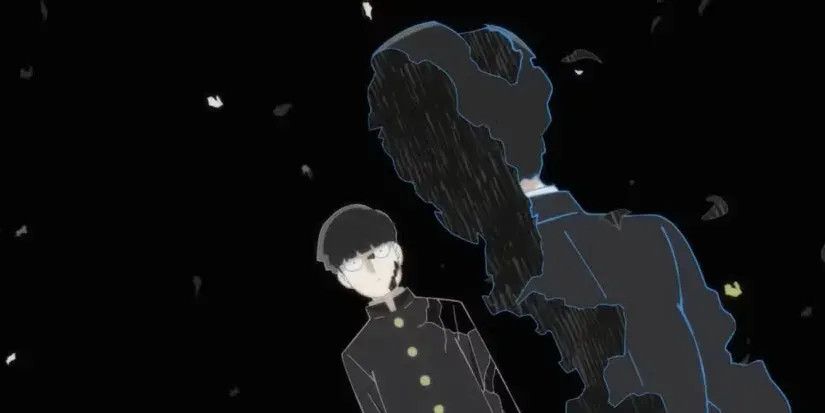
To walk down the mountain and live in the ordinary world is not a defeat. It is a deliberate, courageous act of maturity. Like Mob, we must realize that whatever gifts, insights, or raw power we unearthed during our dark night of the soul mean nothing if they only serve to isolate us from the human race. The ultimate victory is not sitting on a high throne made of your past revelations — it is putting on your running shoes, opening your door, and learning how to be a person among persons.
II. Generational Grace & The Revolution of Kindness
The Architecture of the Inheritance
When we dismantle the rigid moral courtroom of our minds — when we step away from the urge to sit as supreme judge over our lives — we inevitably stumble upon the phantom blueprints left behind by those who came before us.
We do not enter this world as clean slates. We inherit a complex, multi-layered psychic estate: physical traits, joint aches, predispositions to worry, unspoken family taboos, and implicit instructions on how a “proper” life ought to be lived. For a long time, the maturing ego views this inheritance as a hostile occupation. We look at our parents and elders not as regular human beings, but as towering monolithic architectures — archetypal figures who hold the keys to our validation, or heavy gatekeepers who constrained our expansion.
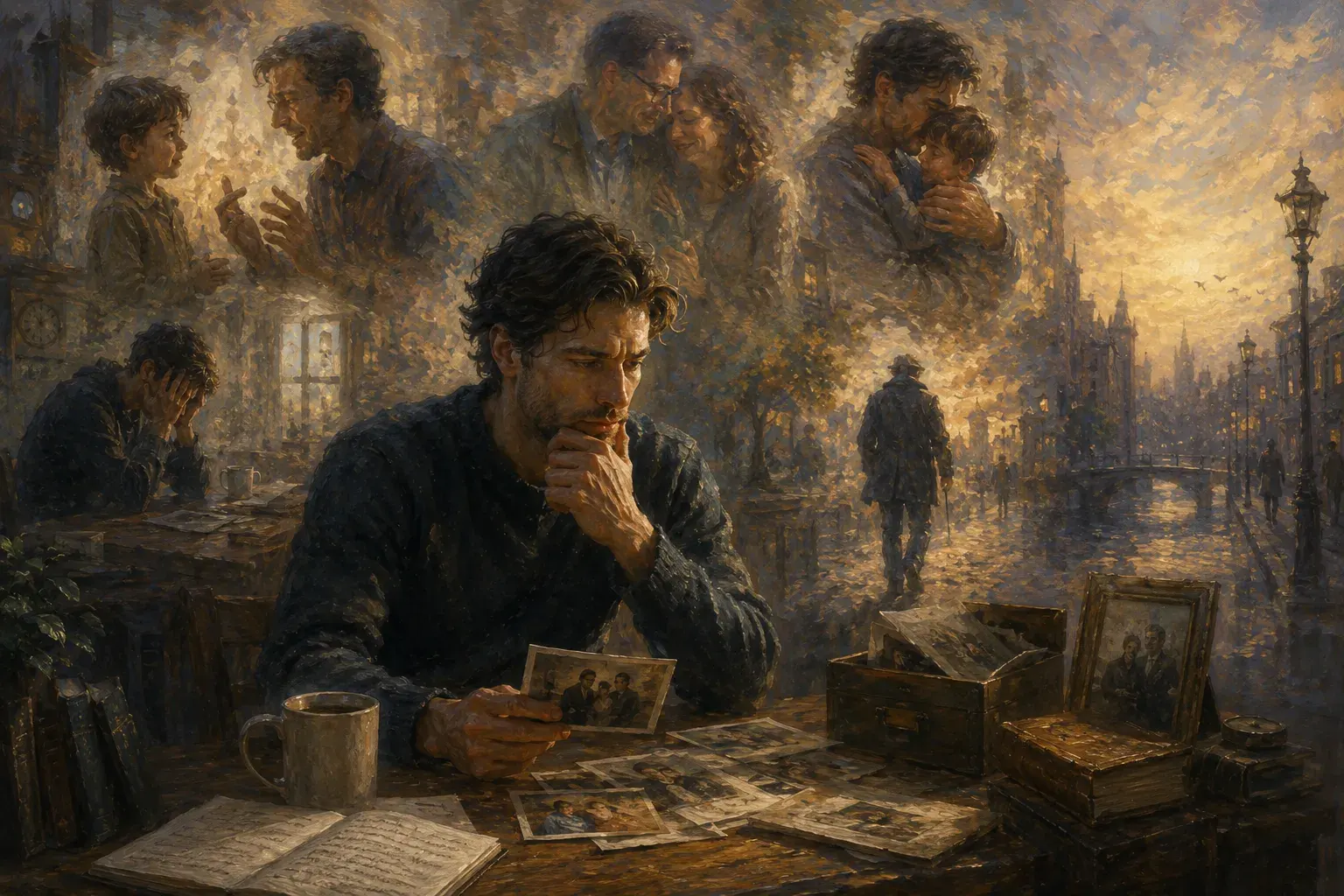
The philosopher Alain de Botton, from The School of Life, points out a subtle, devastating tragedy of the human condition: in our youth, we view our parents through a lens of absolute, terrifying competence. We assume that because they are adults, they must possess an internal manual for existence. When they fail us, react with anger, or project their anxieties onto us, we interpret it as deliberate, authoritative judgment.
What we fail to grasp — and what takes decades to fully understand — is that everyone is playing the Game of Life on “Player 1” mode.
Our parents were never omnipotent guardians or background NPCs designed to serve our character arc. They were terrified, overwhelmed children who aged into adult bodies, faking certainty in a chaotic cosmos, carrying their own unhealed ancestral scars while trying to shield us from a cold wind they could barely withstand themselves. They were main characters in their own messy, unfinished tragedies.
When you realize that your parents felt just as lost, just as lonely, and just as uncertain on a Tuesday evening as you do right now, something fundamental shifts inside your psyche. The heavy judge’s gavel slips from your hand. You realize that demanding total understanding or perfect parenting from them is like demanding that a drowning person hand you a life jacket.
The Intersecting Rings of Causality
Consider existence as a multi-dimensional field of intersecting circles. Each person’s life is a ring of causality, spinning on its own axis, propelled by past traumas, historical circumstances, and inherited fears.
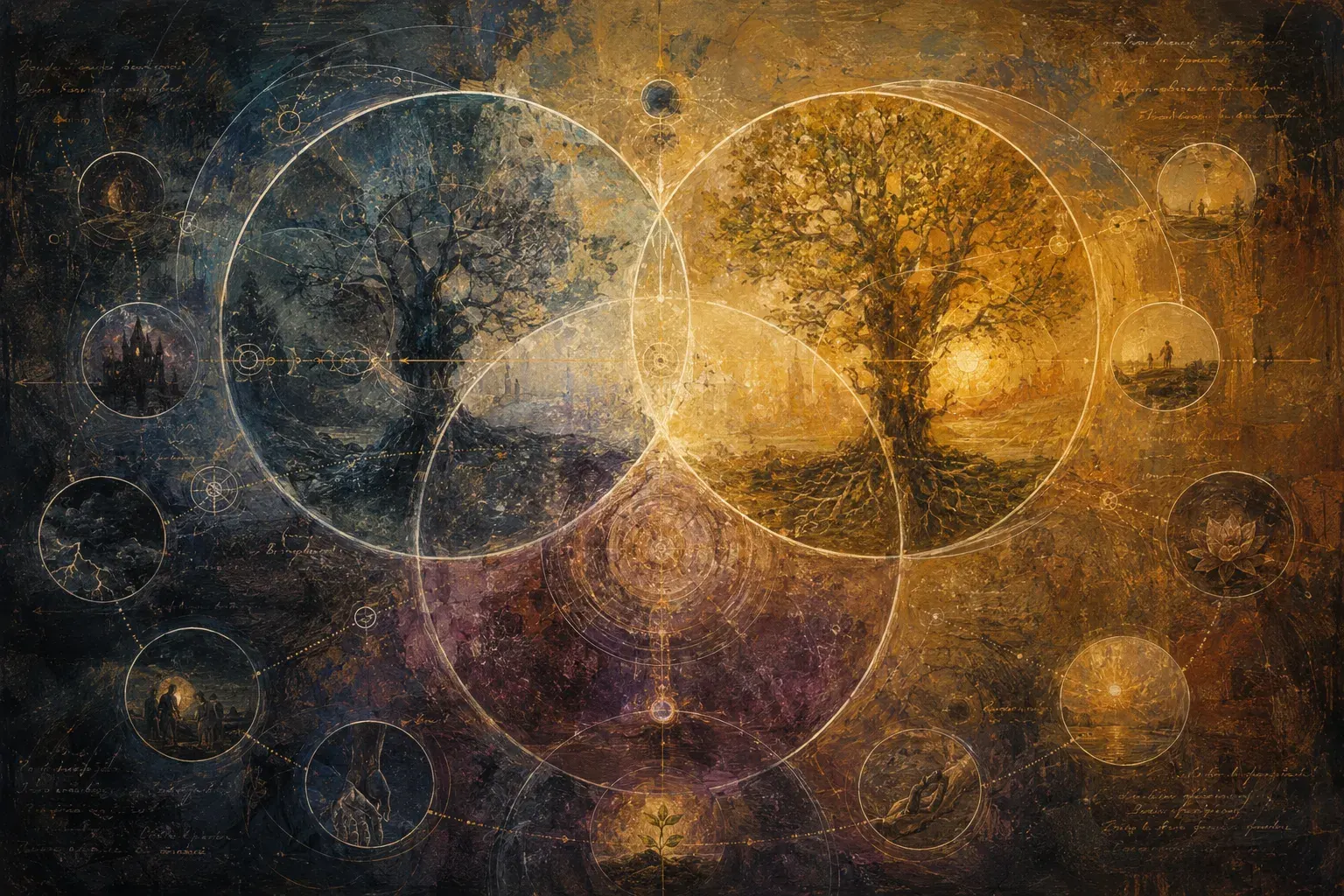
When your circle intersects with your parents’ or your family’s, friction is inevitable. Their fears project onto your future; your longings clash with their unfulfilled dreams. For generations, the human response to this friction has been a law of continuous regression — an eye for an eye, an anxiety for an anxiety, passing the hot potato of unresolved shadow down the ancestral line.
Breakthrough psychological maturity occurs when you realize that epistemic kindness is not a sign of soft weakness; it is an act of supreme narrative violence against continuous trauma.
It is the conscious decision to look at the ancestral chain of fear, expectation, and resentment, and say: The buck stops here. I will not pass the debt forward.
To view your elders with grace is to do the work Jung located in what later analysts called the transgenerational complex — the inherited architecture of unmetabolized fear passed silently from parent to child. You acknowledge that their rigidity was armor built for a war you never had to fight, and in naming the complex, you stop it from replicating unconsciously through you. When you forgive their limitations, you aren’t just releasing them from your internal courtroom—you are liberating your own inner child from having to keep fighting a war that ended twenty years ago.
The Counter-Revolution of the Googly Eye
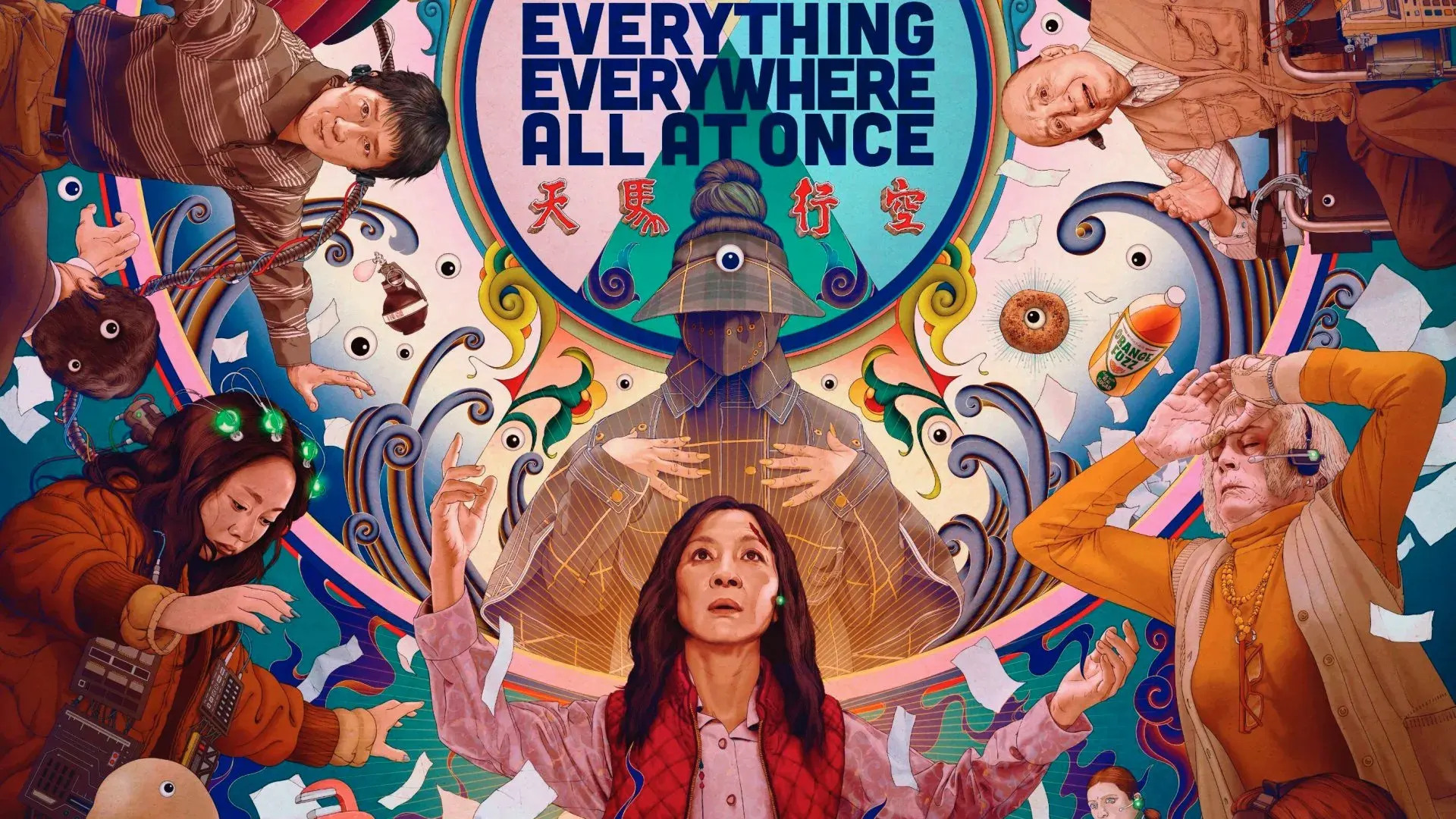
If Jobu Tupaki’s “Everything Bagel” in Everything Everywhere All at Once represents the ultimate modern abyss—the nihilistic realization that in an infinite, absurd multiverse, nothing we do matters—then Waymond Wang (played by the very cool Ke Huy Quan) represents the most radical, mind-bending philosophical response available to a human being.
Nihilism is easy. Collapsing into cynicism when faced with the overwhelming noise of modern life, tax audits, failing relationships, and generational disconnect requires no courage at all. It is a passive surrender to the Void.
Waymond’s weapon of choice in a collapsing multiverse is not a sword, a spell, or an intellectual argument. It is a pair of plastic googly eyes placed gently on a laundry bag.
Waymond is not naive. He is not ignorant of the pain, the disappointment, or the flat texture of his life in the laundromat. He understands the absurdity of existence just as clearly as Jobu Tupaki does. But where Jobu looks at the cosmic void and concludes that nothing matters, so why care?, Waymond flips the axis of the proposition:
“When nothing matters, the only thing that makes sense is to be kind.”

Waymond’s kindness is an intentional, strategic act of tactical grace. In a world governed by crushing efficiency, bureaucratic judgment, and generational hostility, gentle humor and silly affection are acts of high-level subversion. He fights with kindness not because he is too weak to be angry, but because he is strong enough to know that anger only accelerates the entropy of the world.
When we bring Waymond’s philosophy into our own domestic lives, the mundane becomes holy. Cooking a meal for someone who disappointed you, placing googly eyes on a chore list, responding to an anxious relative with patient quietude rather than defensive intellect—these are not small, trivial acts. They are the exact points where the cosmic spiral of suffering is inverted.
You do not need to save the multiverse to live a heroic life. You only need to sit across the table from another scared human being, look past their armor, and offer them the one thing the rigid world denies them: a space where they do not have to be anything other than what they are.
III. The Solarpunk Garden: Carving Narrative Destiny
Re-Enchantment in the Ashes of the Old World
When the high, golden orders of our youth crumble—when we realize that no overarching institution, dogmatic religion, or ideological system is coming to save us—the psyche experiences a profound void. The initial reaction to this collapse is often nostalgia: a desperate, aching longing to restore the shattered paradise, to rebuild the pristine marble towers exactly as they were.
But you cannot step into the same river twice, and you cannot rebuild an old innocence once the shadow has been seen. The psyche doesn’t move backward from collapse to innocence — it moves forward, from a golden order that shatters, through the nihilism of the ruins, into something closer to re-enchantment: not paradise restored, but a garden planted in what’s left.
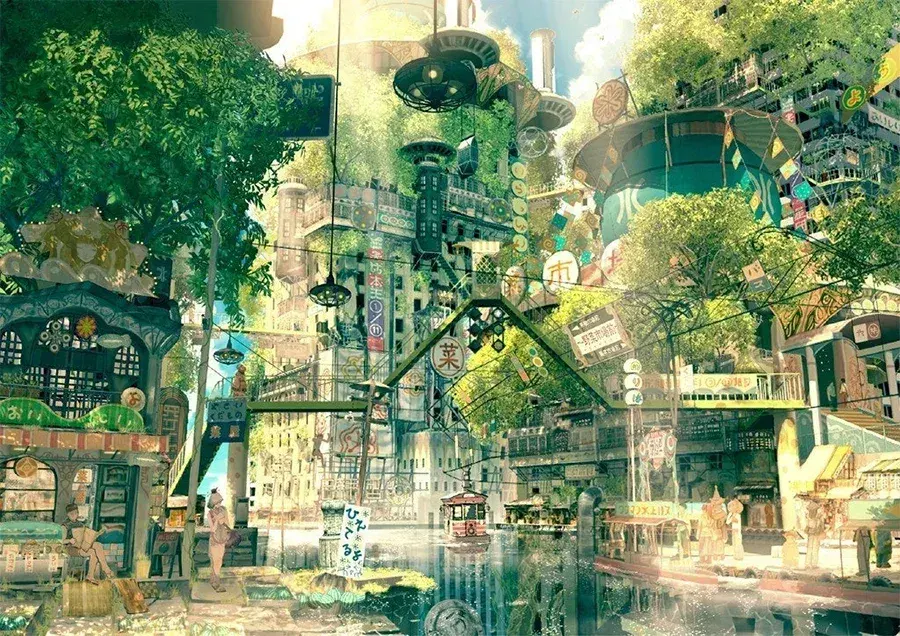
This is where the ethos of Solarpunk offers a radical alternative to both naive utopianism and apocalyptic despair. Solarpunk does not pretend the machine didn’t break down, nor does it dream of escaping to a pristine, untouched Eden. Instead, it asks a far more practical, beautiful question: How do we plant living gardens inside the rusted machinery of the old world?
In Jungian psychology, this is the true meaning of the “Treasure Hard to Attain.” The gold discovered during the dark night of the soul was never meant to be hoarded in an isolated ivory tower, nor was it meant to be used as a weapon to conquer others. It was meant to be brought back down to the flat plains of life to fertilize the soil.
Re-enchantment is not a passive state of wonder that happens to you; it is a stubborn, deliberate act of cultivation. When external dogmas crumble and the golden orders of society lose their authority, human sanity requires the conscious construction of a personal myth—not as an egoic fantasy, but as a living, self-authored compass to navigate the void. It is the choice to look at a grey, algorithmic, highly utilitarian modern landscape and decide to infuse it with your own divine narrative, hand-crafted meaning, and living beauty.
The Scouring of the Shire: Samwise’s Dirt
In J.R.R. Tolkien’s The Lord of the Rings, the true climax of the narrative is famously misunderstood, partly to blame due to it being entirely cut from the movies. It is not the dramatic eruption of Mount Doom or the downfall of Sauron. The true emotional apex occurs in the penultimate chapter: The Scouring of the Shire.
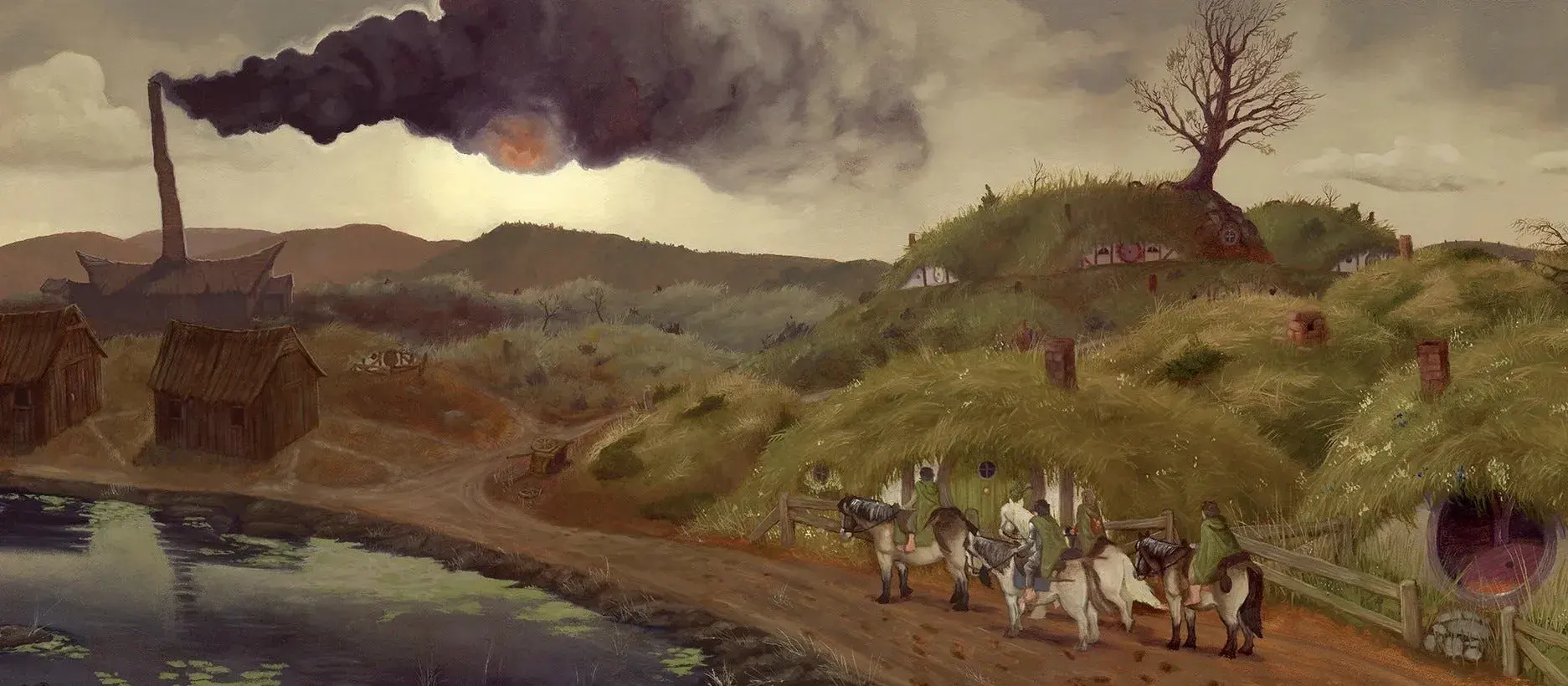
When Frodo, Sam, Merry, and Pippin return to their homeland after saving the world, they do not find a peaceful, untouched paradise waiting to reward them. They find the Shire corrupted, industrialised, and impoverished by Saruman—a tyrant who turned their lush green haven into a grey landscape of smokestacks, polluted streams, and petty rules.
Frodo, bearing the invisible, unhealable scars of the Ring, is too exhausted to rebuild. It is Samwise Gamgee who steps forward to perform the ultimate act of Solarpunk restoration.
Sam opens the small wooden box given to him by the elf-queen Galadriel in Lothlórien. Inside is not a magical weapon or a crown, but a handful of grey dust and a single silver nut from the Mallorn tree. Sam does not use this gift to build a monument to himself. He walks the ruined length of the Shire, planting the dust at the roots of scorched trees, burying the seed in the damaged soil, and tending the earth day after day.
The lesson of Samwise is profoundly sobering for anyone returning from their own psychological wars:
After the cosmic conflict is over, you still have to clear the weeds from your own backyard.
The ultimate proof of your transformation is not that you survived the volcano, but that you returned home and used the ashes of past destruction to make the soil fertile enough for something new to grow.
Living Alongside the Wild: Princess Mononoke & Outer Wilds
Where Samwise teaches us how to plant, Hayao Miyazaki’s Princess Mononoke teaches us the messy, unromantic posture required to sustain the garden.

Princess Mononoke refuses the comforting lie of absolute moral victory. Prince Ashitaka does not end the war between Iron Town’s industrial machine and the ancient spirits of the forest by destroying one side to save the other. Lady Eboshi is not an irredeemable villain; she is a compassionate leader who shelters lepers and freed women, yet her drive for human progress threatens to butcher the divine Great Forest Spirit.
Ashitaka’s burden—and his quiet heroism—is to bear the agonizing curse on his arm while refusing to yield to hatred for either side. He stands between the iron rifle and the wild wolf, declaring a philosophy of radical, difficult co-existence:
“To see with eyes unclouded by hate.”
To cultivate a Solarpunk existence in the modern world is to accept Ashitaka’s vision. You do not achieve peace by declaring total war on technology, society, or modern convenience, nor do you surrender your soul to the machine. You learn the difficult, quiet discipline of living alongside the wild—honoring your primal, sacred inner nature while working within the concrete reality of the modern world.
This finds its ultimate cosmic rhyme in Outer Wilds. When faced with the inescapable, natural death of an entire solar system, the player character does not panic, build a weapon, or try to rewrite the laws of physics. They sit around a campfire at the end of time with a ragtag group of alien travelers, playing music on banjos and flutes while roasting marshmallows. They accept the collapse of the old universe not with despair, but with gentle gratitude, knowing that their songs will feed the creation of whatever new cosmos comes next.
The Cold, Sovereign Path: Ranni’s Vow
Yet, planting a garden in a ruined world requires more than gentle sentimentality. It requires a blade. It requires what can only be described as epistemic sovereignty—the fierce, unyielding refusal to let society, family, or circumstance force you into a convenient, pre-packaged narrative mold.
In Elden Ring, the demigod Ranni the Witch exemplifies this terrifyingly beautiful posture.
Ranni was born into a divine system—the Greater Will and the Golden Order—that dictated every aspect of her existence. She was designated an “Empyrean,” a chosen vessel meant to perpetuate a celestial tyranny disguised as holy grace. The Golden Order offered her power, status, and a gilded throne, provided she surrendered her autonomy and played her assigned role in their cosmic play.
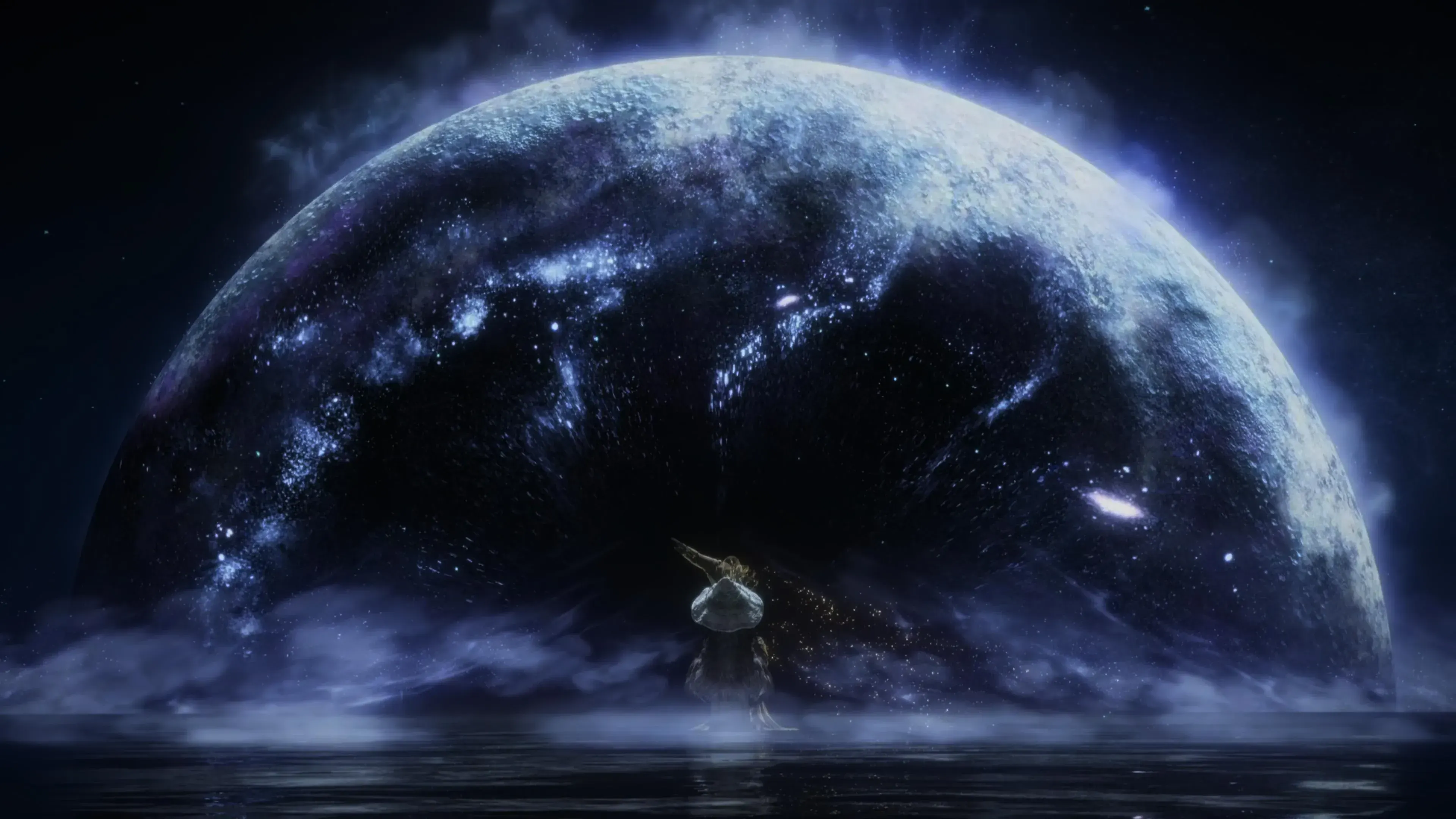
Ranni rejected the gilded cage entirely.
In an act of supreme narrative rebellion, she slew her own divine flesh, shed her prescribed destiny, and bound her spirit to a four-armed wooden doll. She turned her back on the shining, suffocating gold of the Erdtree to usher in the Age of the Stars — a path of quiet, cold night, where humanity is freed from the meddling of distant gods and left to navigate their own fates under the open sky — under their own agency.
""I do solemnly swear, to every living being and every living soul. Now cometh the Age of the Stars. A thousand year voyage under the wisdom of the moon. Here beginneth the chill night that encompasses all, reaching the great beyond. Into fear, doubt, and loneliness… as the path stretcheth into darkness.”
Society, algorithms, and cultural expectations will constantly offer you convenient, pre-scripted roles to play: the successful corporate climber, the tragic victim, the rebellious outcast, the dutiful caretaker. They want your life to fit a predictable story arc that serves their comfort.
Carving your own narrative destiny means having the quiet, stubborn courage to say: I refuse your golden order. I will not play the character you wrote for me. You shed the expectations that were never yours to carry, step out into the quiet night of your own sovereignty, and begin building a life that answers only to the truth of your integrated soul.
IV. The Digital Ark: Science, Soul, and Sovereignty
The Ephemeral Void and the Quest for Anchors
Ranni’s sovereignty was over her own myth. The next sovereignty demanded of us is quieter, and easier to lose without noticing: agency over our own record of ourselves. Currently we live in an age of profound digital liquidity. Culture, memory, media, and human thought have been converted into weightless, floating bits, rented out on cloud servers and curated by opaque algorithms designed to harvest attention rather than nurture depth.
When everything is streamed, subscribed to, and subject to corporate deletion at a moment’s notice, our internal landscapes risk reflecting that same weightlessness. We become nomadic consumers of ephemeral noise, floating through a digital void without an anchor.
It is here that we encounter a central dualism of the human experience: Science and Art, the Void and the Soul.
Science is our discipline for understanding the mechanics of the Void world—the raw physical laws, hardware pipelines, database schemas, network architectures, and cause-and-effect structures that govern reality. Art, on the other hand, is our language for knowing the God soul — the qualitative, irrational, deeply personal weight of human meaning, grief, love, and memory.
The tragedy of modern tech culture is that it treats these two halves as enemies. Technology is stripped of soul and treated as a mere engine for convenience or profit, while spiritual and artistic life is treated as a fleeting fantasy disconnected from tangible physical reality.
True psychological sovereignty in the modern world requires a marriage of both. It requires using the tools of the Void to build a home for the Soul. Hardware must be infused with the divine spark of human intention.
Altered Items: Infusing the Mundane with Soul
In the world of Remedy’s Control and Alan Wake, the boundary between everyday objects and high, reality-altering cosmic power is paper-thin.
Within the sterile, brutalist concrete halls of the Federal Bureau of Control, researchers catalogue “Altered Items” and “Objects of Power.” These are not alien artifacts forged in distant galaxies; they are ordinary, mundane human objects — a vintage slide projector, an old rotary telephone, a floppy disk, a thermos, a typewriter, or a vinyl record player.
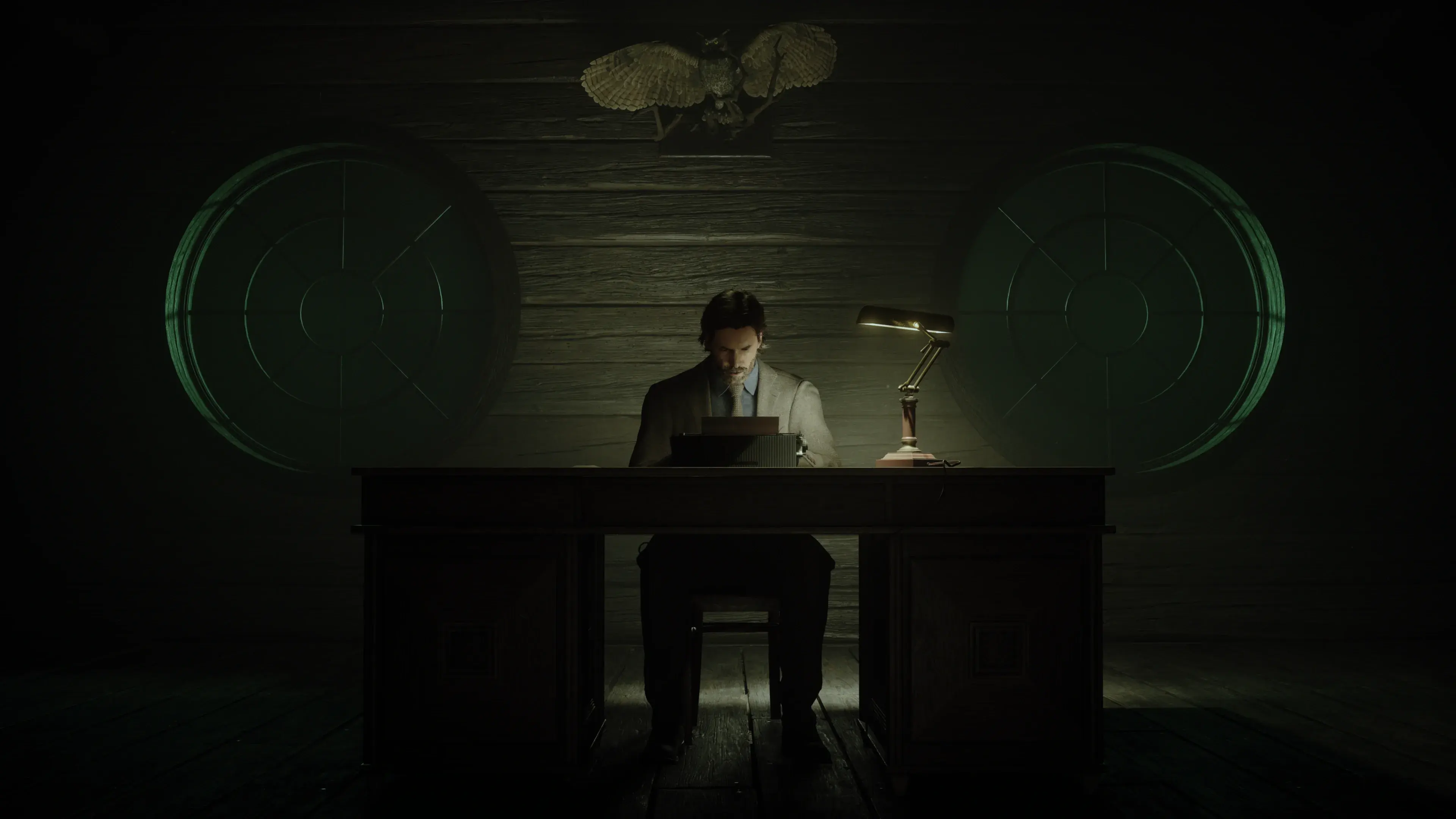
These items become “altered” because human consciousness, collective emotion, and focused narrative weight have poured into them over time. A simple typewriter in a cabin on Cauldron Lake becomes a reality-shaping conduit not because of its mechanical gears, but because an artist used it to pour out his grief, terror, and love into a story. This is close to what Ernst Cassirer (renowned for idealistic neo-Kantianism) meant by a symbolic form, and what Jung meant by active imagination: the process by which a physical object becomes a vessel that an autonomous piece of the psyche can inhabit. The typewriter isn’t magic. It’s a hinge between the Void and the Soul, and the hinge only exists because someone chose to use it as one.
This provides an astonishing lens for how we relate to our personal environments in the real world.
When you take control of your digital infrastructure — when you set up a home server, build a private media archive, keep a physical journal, or carefully curate a library of books and music — you are doing something far deeper than managing files. You are creating your own Objects of Power.
You are taking cold, sterile silicon chips, local storage drives, and lines of configuration code (the Void) and infusing them with personal narrative, memory, and intention (the Soul). A self-hosted sanctuary is not just a geeky hobby; it is a Personal Citadel. It is a declaration that your memories, your aesthetic tastes, and your intellectual lineage are sacred grounds that will not be farmed out to the highest bidder or erased by a corporate terms-of-service update.
The Android’s Prayer: NieR: Automata
If Control shows us how mundane objects hold soul, NieR: Automata asks the ultimate existential question: What do you do when the world that birthed you is completely gone, and all that remains is the cold data?
Set in a distant future where humanity has long been extinct, NieR: Automata follows androids 2B and 9S as they fight an endless proxy war against alien machines. The androids are programmed to defend humanity, unaware that their creators are dead.
Yet, in the absence of humans, something miraculous and haunting happens: both the androids and the machines begin to mimic human culture. They collect ancient books, create art, learn to love, form families, play music, and attempt to build peaceful societies in the ruins. They do not do this because they are programmed to; they do it because the void of existence demands meaning.
Even in a world stripped of its gods, the act of preserving art, music, and ritual is how synthetic beings forge a genuine human soul.
There is a devastating beauty to the machines in NieR stubbornly tending broken flowerbeds, trying to understand philosophy, and guarding ancient archives of human music. They become more human than their creators ever were, simply because they treat human legacy as a sacred trust worth dying for.
In a hyper-commercialized world that encourages us to forget yesterday’s culture in favor of tomorrow’s viral trend, we are called to be like the androids of NieR.
Building a digital ark — curating the films that changed your life, saving the albums that carried you through heartbreak, keeping digital logs of your thoughts, and preserving family histories — is an act of profound preservation. It is how we refuse cultural amnesia. When you archive what you love, you are standing in the digital storm and saying: This mattered. This held a soul. And I will keep the light burning.
V. The Spiral Home: The Feast of Integration
The Resolution of the Spiral
There is a timeless paradox in Zen philosophy that captures the hidden geometry of human transformation: Before enlightenment, chop wood, carry water. After enlightenment, chop wood, carry water.
When we first begin our psychological journey, the ordinary tasks of life — washing dishes, maintaining relationships, organizing files, paying bills — feel like a suffocating prison. We dream of escaping to a higher realm of pure spirit, grand intellectual achievement, or mythic adventure. We want to be anywhere other than where we are.
So we descend into the alchemical furnace. We fight our shadow in the dark, dismantle our rigid moral courtrooms, confront inherited ancestral traumas, and carve out our own sovereign narrative. Yet when the dust settles and the high fires fade, we discover that the path of the spiral has led us back to the exact same kitchen sink where we began.
The sink has not changed. The wood still needs to be chopped, and the water still needs to be carried. What has changed is the hand holding the bucket.
You are back at the beginning, but you are standing at a higher elevation on the spiral. The ordinary is no longer a prison to escape; it has become a sanctuary to inhabit. You no longer chop wood to become a hero; you chop wood because keeping the home warm is an act of quiet, sacred presence.
The Ouroboros Feast: Delicious in Dungeon
This entire three-part journey finds its ultimate, beautiful rhyme in the climax of Delicious in Dungeon (Dungeon Meshi).
In our first essay, we used Senshi’s cooking as an alchemical metaphor for Albedo — the painful, necessary process of breaking down raw, terrifying monsters, digesting trauma, and extracting nourishment from what once threatened to destroy us. We descended into the dark depths of the dungeon to rescue what was lost.
Yet, Delicious in Dungeon does not end with its heroes becoming immortal kings, ruling from isolated high towers, or vanishing into a cosmic ether. After defeating the Winged Lion — the cosmic entity that weaponized infinite, insatiable human desire — the party’s ultimate victory is deceptively simple.
They gather in the ruined, sunlit courtyard of the dungeon, pull up wooden chairs around a long table, and sit down to share a home-cooked meal made from everything they encountered along the road.
They eat together. They toast to the living and honor the dead. They laugh, bicker, pass the serving plates, and digest the entire journey — the good, the horrific, the ridiculous, and the sacred — in the company of those they love.
If the first essay (Shadows & Stardust) was the nigredo — the blackening, the descent into the furnace — and the second (Letter of Sympathy for the Devil) was a kind of citrinitas, the dawning solar clarity of the courtroom dissolving into understanding, then this would be the rubedo: alchemy’s final stage, where the gold stops being a symbol kept behind glass and becomes something you can put in your mouth. Bread. A shared meal. A home.
This is the Ouroboros brought to its divine completion: First, the Furnace—confronting the shadow in the dark. Then, the Courtroom—dissolving judgment into understanding. Finally, the Table—sharing the feast of integration.
The monster that was once a nightmare in the dark becomes the bread shared at the table. The trauma that once fragmented your soul becomes the wisdom that allows you to offer deep, unconditional empathy to another human being sitting across from you.
Setting the Table: The Triptych’s Final Vow
To live an integrated life is to recognize that we are all, at our core, the inner child who was simply forced to grow up and fake it till we made it.
We spent years building elaborate suits of armor — intellectual cynicism, high moral judgment, grandiose ambitions, or defensive detachment — to protect that child from a scary, chaotic world. But once you realize that the world is no longer something to be feared or conquered, you can finally take off the armor. You can hang the sword by the fireplace, open the heavy oak door, and invite your inner child to sit down at the table.
The furnace was survived. The courtroom was understood and dissolved. And now, the table is set.
The ultimate act of shadow integration, epistemic kindness, and Solarpunk re-enchantment is not a grand, dramatic spectacle. It is making your own home, your own self-hosted digital spaces, your own daily work, and your own relationships a place where light and shadow dance together in peace.
You do not need a cosmic stage to live a heroic life. You only need to chop your wood, carry your water, build your garden in the ruins, keep your digital hearth warm, and make sure that whenever someone sits down at your table, they find a hot meal, a listening ear, and a space where they are allowed to be fully, beautifully human.
[ Read the previous two parts here: Part I - Shadows & Stardust and Part II - Letter of Sympathy for the Devil ]